Yearly Archives: 2023

Spelling with Morphology and Etymology

History

As children develop an awareness of words and the units of meaning within words, it is good to give them then chance to explore related words and their literal or metaphorical meanings.

If you wish to try this out with your class, you can use this information sheet

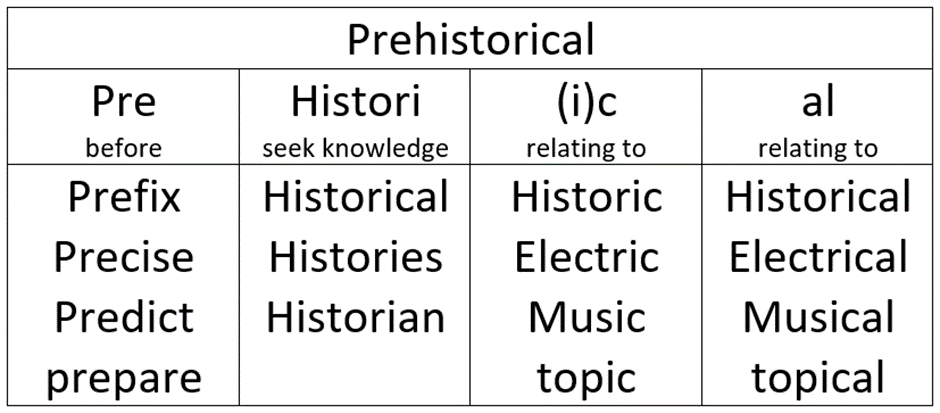
This week we are looking at the words which contain the root histori(y) meaning to know or to seek knowledge.

You can use this in conjunction with the independent group work programme, Pick and Mix, or you may wish to work through the accompanying sheet with your whole class.

Working this way, not only links meaning to spelling patterns, but it also helps readers to understand words that are new to them. This week, we will learn the difference between hist and hyst.
Spelling with Morphology and Etymology

September, October, November, and December

As children develop an awareness of words and the units of meaning within words, it is good to give them then chance to explore related words and their literal or metaphorical meanings.

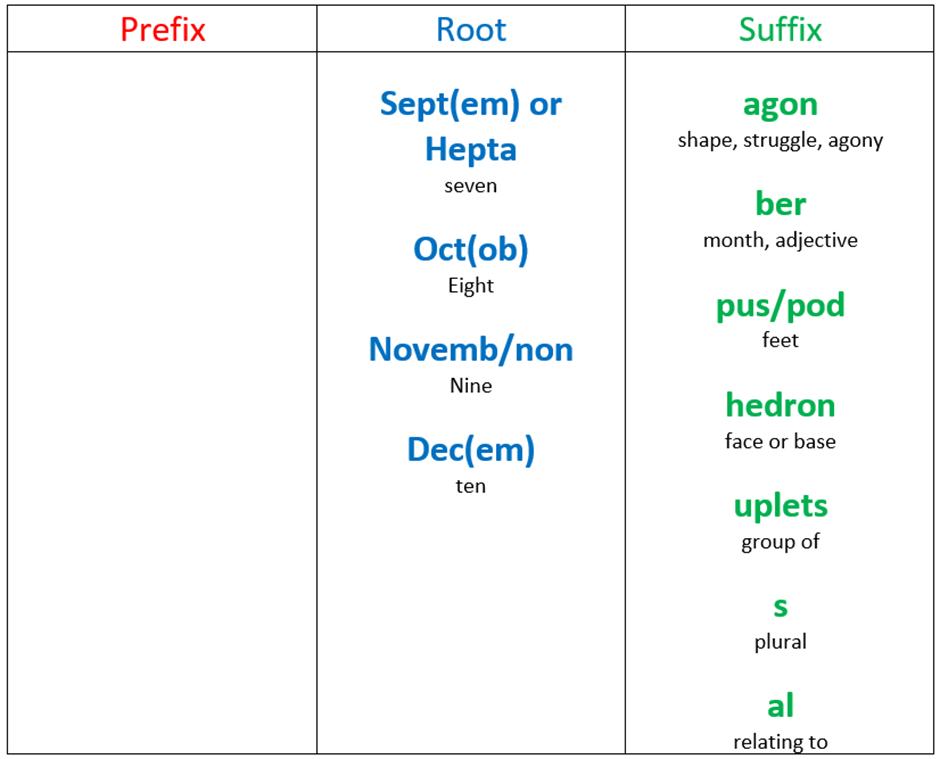
If you wish to try this out with your class, you can use this information sheet.  This week we are looking at the words which contain the root meanings of the last four months of the year.

Why does Sept mean seven and yet September is the ninth month of the year?

Why does Octo mean eight and yet October is the tenth month of the year?

Why does Novem mean nine and yet November is the eleventh month of the year?

And why is the twelfth month, December spelt with Dece, meaning ten?

You can use this in conjunction with the independent group work programme, Pick and Mix, or you may wish to work through the accompanying sheet with your whole class.

Working this way, not only links meaning to spelling patterns, but it also helps readers to understand words that are new to them.

Spelling with Morphology and Etymology

Capture

As children develop an awareness of words and the units of meaning within words, it is good to give them then chance to explore related words and their literal or metaphorical meanings.

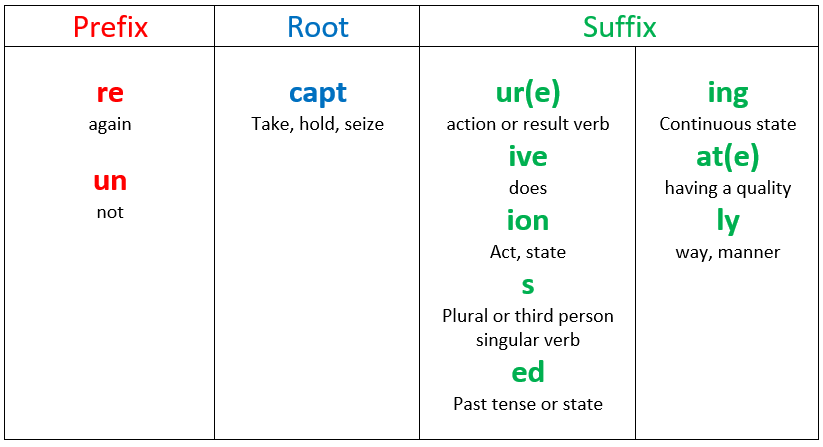
If you wish to try this out with your class, you can use this information sheet.  This week we are looking at the words which contain the root capt meaning to take, hold, or seize.

You can use this in conjunction with the independent group work programme, Pick and Mix, or you may wish to work through the accompanying sheet with your whole class.

Working this way, not only links meaning to spelling patterns, but it also helps readers to understand words that are new to them.

Spelling with Morphology and Etymology

Accept, concept, except

As children develop an awareness of words and the units of meaning within words, it is good to give them then chance to explore related words and their literal or metaphorical meanings.

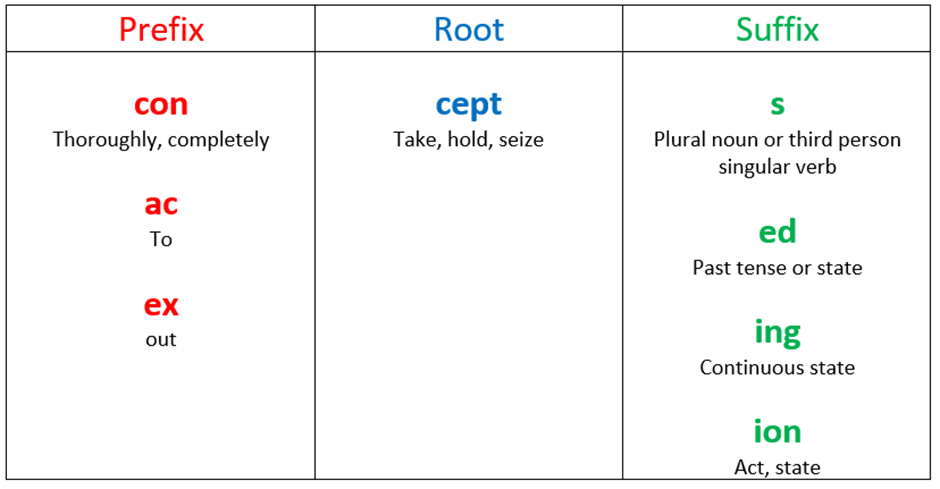
If you wish to try this out with your class, you can use this information sheet.  This week we are looking at the words which contain the root cept meaning to take, hold, or seize.

You can use this in conjunction with the independent group work programme, Pick and Mix, or you may wish to work through the accompanying sheet with your whole class.

Working this way, not only links meaning to spelling patterns, but it also helps readers to understand words that are new to them.

Spelling with Morphology and Etymology

Spelling with Morphology and Etymology

As children develop an awareness of words and the units of meaning within words, it is good to give them then chance to explore related words and their literal or metaphorical meanings.

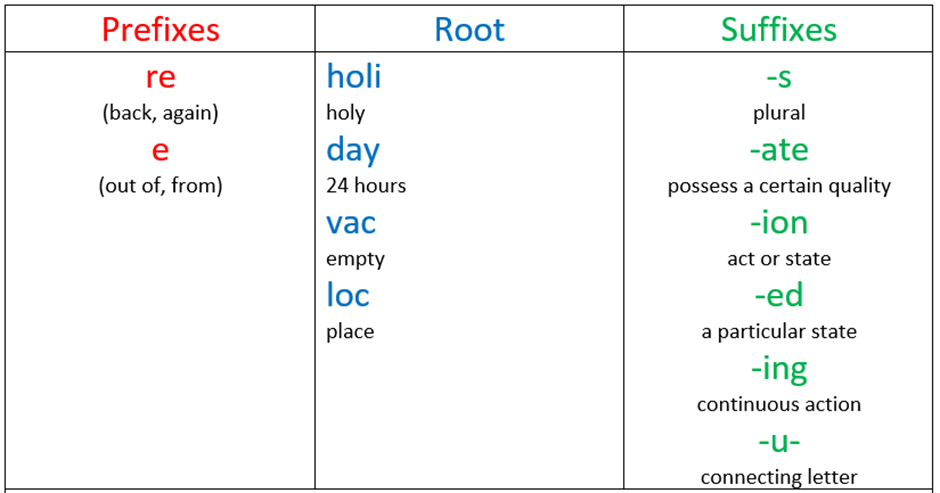
If you wish to try this out with your class, you can use this information sheet.  This week we are looking at the words holiday and vacation.

You can use this in conjunction with the independent group work programme, Pick and Mix, or you may wish to work through the accompanying sheet with your whole class.

Working this way, not only links meaning to spelling patterns, but it also helps readers to understand words that are new to them.

Literacy CPD Opportunities

CPD Opportunities for 2023/24

Once again there is a full menu of CPD opportunities for literacy in Highland Council this year. 

You will find the list on the link below.

If you are interested in joining any of the events or workshops, please sign up through the CPD calendar.

You will find it by going to the Intranet for school staff >

Schools’ hub >

Essential School Links >

CPD.

All trainings will be on-line and you will be able to access the code when you sign up.

Become a Reading School!

Begin your Reading Schools journey

Have you ever considered working with the Scottish Book Trust to become a Reading School? Why not celebrate the magic of books and reading in your school and become a Reading School!

Reading Schools has practical resources, friendly support and a variety of accreditation levels designed to champion your efforts as you build and sustain a reading culture. Scottish Book Trust is a registered company (SC184248) and a Scottish charity (SC027669).

‘Through Reading Schools, pupils have a broad knowledge of books and authors and are always looking for ways to improve their reading skills, understanding and reading habits.’ – Acting Principal teacher (Primary)

Become a Reading School in three steps:

Step 1 – Planning
Use our self-evaluation template, surveys and level quiz to choose from a Core, Silver or Gold award and apply your thinking in submission of your action plan.

Step 2 – Enjoying
Enjoy your reading across the school. Take photos, keep notes and share your journey with us and the Reading Schools Community.

Step 3 – Celebrating
Submit your evidence through your Reading Schools
dashboard to gain your national accreditation and celebrate!

Join the nationwide Reading Schools community and apply now at www. https://www.scottishbooktrust.com/learning-and-resources/reading-schools

0131 524 0160

Emerging Literacy Network 4

The forth Emerging Literacy Network will run on Thursday 1st June 2023 from 15:45 to 16:45.

We will be focusing on Transition and Achievement of a Level.

This network will provide the opportunity to ask questions and share best practice around Transition and the Achievement of a Level.

Practitioners in Highland Council should sign up through the CPD calendar.

Vocabulary

A Whole School Approach to Developing Vocabulary

As we know, vocabulary plays an important role in being able to express ourselves accurately both in speech and in the written text.  As such, it is important in our developing sense of self.  Where we cannot adequately express our feelings, our wants, our needs or opinions, it can lead to a sense of frustration and heightened levels of anxiety.

When children are reading, if a word is not in their vocabulary, it can mean that they cannot be confident in how the word should be pronounced or its contribution to the overall meaning of the text.

When writing, many children will reduce their vocabulary because they do not feel confident in spelling the word.  Others will write using a reduced vocabulary because their vocabulary does not contain the words that they could use to make a more deliberate choice to influence or accurately inform their reader.

Vocabulary is best taught in the context of quality spoken and written language, where new words can be used and practised naturally and regularly in context. 

Some ways that will help children to grow and develop their language is through:

  • Quality adult and child conversations, where the adult models words in the context of natural spoken language and the child feels safe to imitate, practise and explore the uses of the word.  Words Up Key Messages
  • Repeated engagement with a shared book, where children hear new words and explore what they mean and have the word explained to them and have the opportunity to use the word in context.
  • Pre-teaching the vocabulary is useful for IDL work or when introducing a new book.  This means that when they hear the word in context, they are able to understand the text more fully.
  • Using semantic gradients is a fun way of learning how to use the correct word for each occasion and developing the skills for using words to influence the audience.
  • Planning for developing vocabulary across the curriculum, using the three tiers of vocabulary approach provides targeted learning and teaching.
  • For older children, learning the morphology of words is useful for building up an understanding of the units of meaning in a word and being able to transfer that knowledge to other words.  Using a word study approach, we look at the meaning of the parts of the word.  We can then use this knowledge to look for other words containing the same morphemes (unit of meaning).  This can be useful for looking at tier two words.

Two morpheme words – word   pdf   Three morpheme words – word    pdf

  • Assessing the growth of vocabulary across the years can also give us a useful indicator of which children require more a more targeted approach.  Vocabulary tracking

The Scottish Book Trust

Here are some of the most recent updates from the Scottish Book Trust.

*Apply for a writer in residence

Live Literature school residencies – Scottish Book Trust

*The First Minister’s writing challenge.  (Enter by Thursday 27th April)

Submitting an entry | First Minister’s Reading Challenge

*Authors live – Jenny Pearson:  The Boy Who Made Monsters (Thursday 15 June)

Authors Live: Jenny Pearson – Scottish Book Trust

If you do not already get the updates and information from the Scottish book trust, then you might find it useful to register to sign up for their newsletters.

Sign up to our newsletters – Scottish Book Trust