Category Archives: Uncategorized

Morphing Around – Understanding how words work 5

This week we will continue to look at words within maths.  Our focus words for this week are centimetre, and percent.

Let’s look at the morphemes (building blocks) in each word.

When we look at the words  centimetre and percentage, you will see that both contain the morpheme cent (hundred).  In centimetre there is an I after cent.  It is a connective sound to make it easier to say, when joining the two morphemes (units of meaning).  Percentage, doesn’t have a connecting sound as the a at the beginning of age, make joining the two morphemes together easy.

Last week we had the word diameter.  Meter means measure.  This week we have centimetre. Metre is spelled slightly different but still means measure but there is a way of knowing which to use.
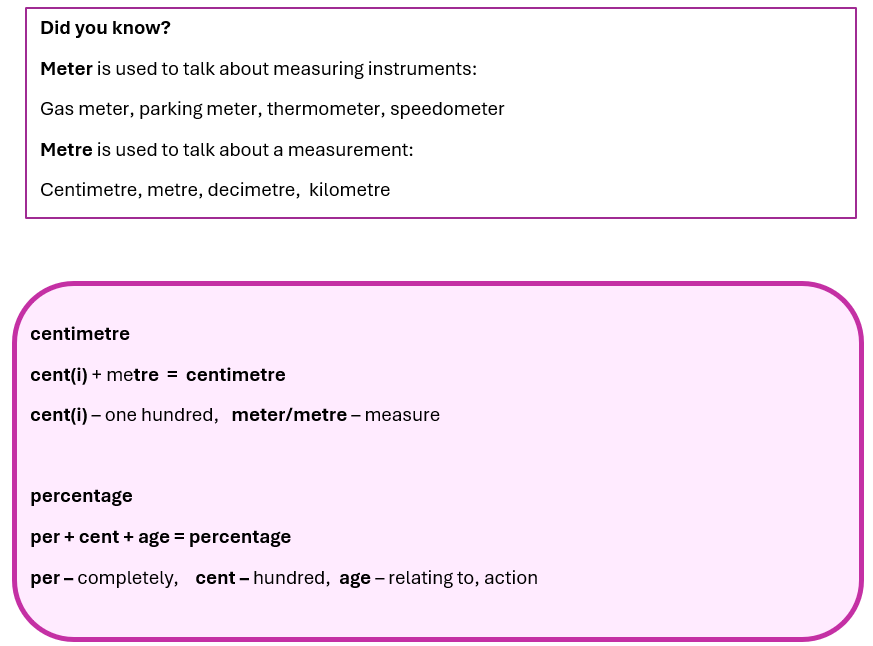
Let’s try to extend our knowledge of these morphemes and identify them in other words.  How do these morphemes help us to understand each word?

Can you think of other words containing each of these morphemes?    I’ve done one in each group for you.  https://membean.com/roots will help you find words, if you are stuck.

Write a word sum for each of the words you have created using the prefixes, root words and suffixes.  E.g. rad + i + ate  + ion = radiation

To use this as a spelling strategy each day of the week, see the weekly plan. 

How to use Pick and Mix each day for a week.

Percent         percentage           percentages         Perimeter     perimeters            millimetre                 millimetres          centimetre             centimetres Meter              meters                   Metre              metric                     metrical                   diametric             diametrical            diametrically Centipede    centipedes           millipede                 millipedes  

For more word explorations, click here.

Useful Tools for understanding and using the morphology of words.

Membean – https://membean.com/roots

Phonicsandstuff – https://phonicsandstuff.com/

Embracing Literacy – https://www.facebook.com/embracing.literacy/

Roots and Affixes already used

Morphing Around – Understanding how words work 4

This week we will continue to look at words within maths.  Our focus words for this week are diameter, and radius.

Let’s look at the morphemes (building blocks) in each word.

When we look at the word radius, you will see an i, in the middle.  It is not a morpheme because it doesn’t carry any unit of meaning.  It is a connective sound to make it easier to say, when joining the two morphemes (units of meaning).

Let’s try to extend our knowledge of these morphemes and identify them in other words.  How do these morphemes help us to understand each word?

Can you think of other words containing each of these morphemes?    I’ve done one in each group for you.  https://membean.com/roots will help you find words, if you are stuck.

Write a word sum for each of the words you have created using the prefixes, root words and suffixes.  E.g. rad + i + ate  + ion = radiation

To use this as a spelling strategy each day of the week, see the weekly plan. 

How to use Pick and Mix each day for a week.

Diameter        diameters     diametric      diametrical       diametrically               
Dialogue         dialogues      dialoguing    dialogued
radius              radii                radiate         radiates             radiation

For more word explorations, click here.

Useful Tools for understanding and using the morphology of words.

Membean – https://membean.com/roots

Phonicsandstuff – https://phonicsandstuff.com/

Embracing Literacy – https://www.facebook.com/embracing.literacy/

It is not important for children to memorise what each morpheme means, but the more they are aware of the different meanings, the easier it will be to get spelling right and understand more fully what a word means.  Morphology is a tool and not a memory exercise.

Prefixes already used

Morphing Around – Understanding how words work 3

This week we will continue to look at words within maths.  Our focus words for this week are multiplication, and division.

Let’s look at the morphemes (building blocks) in each word.

Multiplication

Multi  + plic + ate + ion =  multiplication                       

multi – many,   plic/ply – folds/threads,     ate – to make;   ion – act or state                                                                                

Division

di + vise + ion = division      

di – apart,    vise see or split,  ion – act or state

Let’s try to extend our knowledge of these morphemes and identify them in other words.  How do these morphemes help us to understand each word?

Can you think of other words containing each of these morphemes?    I’ve done one in each group for you.  https://membean.com/roots will help you find words, if you are stuck.

Write a word sum for each of the words you have created using the prefixes, root words and suffixes.  E.g. multi + plic + ate  + ion = multiplication

To use this as a spelling strategy each day of the week, see the weekly plan. 

How to use Pick and Mix each day for a week.

Multiply                multiplies          multiplying         multiplied           multiplication Multinational     multilingual      multiracial          multiracially   
divide                     divider                divides                  dividing                divided                  division                      

For more word explorations, click here.

Useful Tools for understanding and using the morphology of words.

Membean – https://membean.com/roots

Phonicsandstuff – https://phonicsandstuff.com/

Embracing Literacy – https://www.facebook.com/embracing.literacy/

It is not important for children to memorise what each morpheme means, but the more they are aware of the different meanings, the easier it will be to get spelling right and understand more fully what a word means.  Morphology is a tool and not a memory exercise.

Prefixes already used

Morphing Around – Understanding how words work 2

Our focus words for this week are addition, and subtraction.

Now that we are back int the swing of the new academic year, I thought that we could have a look at the morphology of some maths words.

Let’s look at the morphemes (building blocks) in each word.


We can extend our knowledge of these morphemes by identifying them in other words.  How do these morphemes help us to understand each word?

Can you think of other words containing each of these morphemes?    I’ve done one in each group for you.  https://membean.com/roots will help you find words, if you are stuck.

Write a word sum for each of the words you have created using the prefixes, root words and suffixes.  E.g. sub + tract + ion = subtraction

To use this as a spelling strategy each day of the week, see the weekly plan below. 

How to use Pick and Mix each day for a week.

For more word explorations, click here.

It is not important for children to memorise what each morpheme means, but the more they are aware of the different meanings, the easier it will be to get spelling right and understand mor fully what a word means.  Morphology is a tool and not a memory exercise.

Prefixes used in week one:

Useful Tools for understanding and using the morphology of words.

Membean – https://membean.com/roots

Phonicsandstuff – https://phonicsandstuff.com/ Embracing Literacy – https://www.facebook.com/embracing.literacy/

Morphology Friday 1

Morphing Around – Understanding how words work

Our focus root words for this week are holiday and vacation.

Our holidays are over, and it is back to school for a new school year.  Another word for a holiday is a vacation.  It is often used in America, as well as other countries. Both the words holiday and vacation are built from morpheme building blocks (units of meaning).

Let’s look at the morphemes (building blocks) in each word.

holi + day = holiday                       holi – holy;   day – day

vac + ate + ion = vacation            vac = empty; ate = possess a certain quality; ion = act or state

So, a vacation is the state of something being empty.  (empty of work/school)

holi means holy.  It was first used in the 1500s.  Over the years the y has been changed to an i because something is going to be added to it.  People only had extra rest days on holy days such as Sundays, Christmas, and Easter.  Over the years the two words merged into one and became holiday.

The word vacation also means holiday but is used more in America. 

Now let’s try to build some words connected to holiday and vacation. You will not be able to use every prefix or suffix with every root.

Write a word sum for each of the words you have created using the prefixes, root words and suffixes.  E.g. e + vac + u + at + ion = evacuation

To use this as a spelling strategy each day of the week, see the weekly plan. 

How to use Pick and Mix each day for a week.

Here are some words that can be created from this matrix. It is important that the children make sure that they are not creating new words and know how to use them in context.

holiday                    holidays                    holidayed             holidaying                  preholiday                postholiday  (or post-holiday) vacate                     vacation                    vacating                      vacated              prevacation               postvacation              evacuate                 evacuation               evacuating                  evacuated locate                     location                     locating                       located                      relocate                 relocation                  relocating                   relocated

For more word explorations, click here

Scottish Book Trust PL Sessions

We have a new printable poster with QR code links for upcoming Professional Learning sessions which schools can print for the staff room/notice board. https://highlandliteracy.com/wp-content/uploads/2026/08/PL-termly-poster-2-1.pdf

The first round of Read Write Count resources for this year are now available on the website, including:

An article on Top tips for sharing picture books at home

Has your school start its journey to become a Reading School?

Unleash the magic of books and reading by joining our Reading Schools community!

Research proves that reading for pleasure supports equity and wellbeing, impacts learners’ attainment, and encourages critical thinking, creativity, empathy and resilience.

Reading Schools is an accreditation programme for schools that are committing to building a reading culture for their learners and communities.

Through Reading Schools, you can access practical resources and friendly support to help build your reading culture and connect with hundreds of schools across Scotland who have already seen transformational changes to their settings, staff and learners.

There are now 90 schools in Highland at some stage of their accreditation journey with over 600 schools accredited across Scotland.

Reading Schools is open to all schools in Scotland!

Visit our website to find out more about starting your accreditation.

You can also contact your Scottish Book Trust Regional Outreach Co-ordinator for more information and support at jen.grainge@scottishbooktrust.com

Scottish Book Trust,Sandeman House, Trunk’s Close, 55 High Street, Edinburgh, EH1 1SR, Scottish charity, SC027669 

Support Pre-literacy with Bookbug

Support pre-literacy with Bookbug
Join our early years experts for our upcoming online workshop, Before reading begins: the six skills that grow readers on 1 September, 4.30–6pm. In this practical, evidence-informed workshop, we’ll explore the six key pre-literacy skills that lay the foundations for reading – alongside picture books that support each skill, with practical ideas for using them. Designed for anyone working in the early years, and parents, this session will connect research with real life. Book tickets for three or more of our webinars or workshops and you save 20%!
Rectangle: Rounded Corners: Book your place, today!
 

School Library Setup Support

Get help to create the perfect school library…

Libraries For Primaries

Applications are open for support from the National Literacy Trust’s UK-wide ‘Libraries For Primaries’ programme. They can provide training, resources, books and furniture to schools that don’t yet have a school library. This is ideal for any settings working towards embedding a culture of reading for enjoyment. To apply for the 2026/2027 programme, click below.

Emerging Literacy CLPL

Emerging literacy refers to the skills, knowledge, and attitudes that children develop about reading, writing, communication, and language before they become conventional readers and writers. These early experiences form the foundation for later literacy development and include activities such as listening to stories, exploring books, engaging in conversations, drawing, mark-making, and developing phonological awareness.

It is important to support emerging literacy skills in a developmentally appropriate way, recognising that children learn at different rates and through a variety of meaningful, and play-based experiences. Effective practice builds on children’s interests, strengths, and cultural backgrounds while providing rich opportunities for communication, language development, and early literacy exploration. When literacy experiences are aligned with children’s developmental stages, they promote confidence, motivation, and a lifelong love of reading and learning. Conversely, introducing formal literacy expectations too early can create frustration and reduce engagement. A developmentally appropriate approach ensures that literacy learning is enjoyable, inclusive, and responsive to each child’s individual needs.

If you would like to explore this further, or refresh your knowledge on Emerging Literacy, take a look at the information and resources on https://highlandliteracy.com/emerging-literacy/  or join us in the sessions listed below, where we will learn from experts and share ideas, resources and activities. 

Mon 14 Sept 2026 (In-service Day) 9:30 to 15:30 (Venue to be announced)

This whole day session is to train those who have not had training in Emerging Literacy or those wishing to take a lead on regional support networks in Emerging Literacy.

The following sessions will be online and will cover the main areas of Emerging Literacy.

1. Phonological Awareness 26/08/26

2. Oral Language                      30/09/26

3. Concepts of Print                11/11/26

4. Pencil Control                        02/12/26

Sign up through our CPD portal or contact jenny.wilson@highland.gov.uk
