Author Archives: Mr Cook

World Nursery Rhyme Week 2018: 19/11/18 – 23/11/18

Monday 19th November 2018 – Friday 23rd November 2018, is:
World Nursery Rhyme Week

When taking a developmental approach to emerging literacy, nursery rhymes are a great way of supporting the development of literacy, language and communication skills. Get your children involved with the free resources from Music Bug.

CLICK HERE for World Nursery Rhyme Week Information and Registration

“Rhyme a Day Challenge” songs for 2018

  • Monday 19th November 2018: ‘Bobby Shafto’.
  • Tuesday 20th November 2018: ‘Humpty Dumpty’.
  • Wednesday 21st November 2018: ‘A Sailor Went to Sea’.
  • Thursday 22nd November 2017: ‘I’m a Little Teapot’.
  • Friday 23rd November 2017: ‘Round and Round the Garden’.

CLICK HERE – World Nursery Rhyme Week 2018 Resources

Words Up Early (Level 1) – Key Messages Training

The Words Up: Early  (Level 1) Key Messages for Adult/ Child Interaction training has been developed by speech and language therapists in Highland for adults to support their interactions with children, leading to improved speech, language and communication for children. The online training is an alternative to the face to face Level 1 training. To get the most out of the training, it is recommended that this is done within small groups. It will take around 1.5 hours to 2 hours (depending on the length of discussion).

For the training, you will need:
– copies of the Words Up Early and Primary Key Message Posters
– a piece of wrapped fruit (e.g. a tangerine) or a wrapped sweet
– a pen/pencil and paper.

CLICK HERE to access the Words Up Early (Level 1) Key Messages Training

What’s Your Story? – Age 14-17

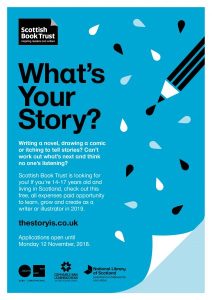
This year the Scottish Book Trust will be selecting seven teenagers from around Scotland to join the What’s Your Story? Development Programme.

They’re looking for people aged 14-17 who want to develop their creative skills in writing, illustration or storytelling. It’s completely free to apply and to take part. All expenses are paid for, wherever you travel from and whatever access support you need.

You can find more information about different activities and the application process on our essential information page. Applications are due Monday 12th November 2018.

Read, Write, Count – P2 and P3 Training

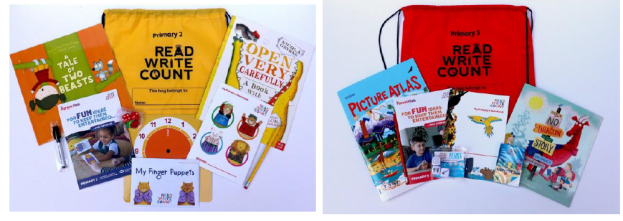
We have just had notification from Tamara Hedderwick at the Scottish Book Trust about online training which is taking place THIS WEEK for those in schools, libraries and third sector organisations who are involved in supporting the Primary 2 and Primary 3 Read, Write, Count packs.

A free, short online training session is available to inspire gifting ideas, start planning an event and guide you to resources the Scottish Book Trust and partners have developed to support learning professionals through the gifting process.

The session also covers where to find support for parental engagement in their child’s learning. If the opportunity to provide support and advice to parents is taken, it increases the chance that the bags will be used effectively at home. How the bags are gifted will have an impact on how the bags are used at home.

Find out more by booking a session during Tuesday 30th October – Thursday 2nd November 2018, at either 2-3pm or 4-5pm on each day. Please book into your preferred session by following the link below:

https://www.eventbrite.co.uk/e/read-write-count-bag-gifting-training-tickets-51868510110

If you cannot make these dates and times please email tamara.hedderwick@scottishbooktrust.com with an expression of interest and she will organise a session with a member of her team in the next few weeks.

CLICK HERE – SBT RWC Information

Pre Teaching Vocabulary (Oral Language Toolkit)

The Pre-Teaching Vocabulary guidance sits as part of the Oral Language Toolkit.

In order to learn new vocabulary and language children need three things simultaneously:

  • experiences

  • adults telling them the words

  • repetition.

CLICK HERE – Pre-Teaching Vocabulary Guidance

CLICK HERE – PTV Training PowerPoint

CLICK HERE – PTV Resources (Pip St. John)

CLICK HERE – PTV Resource Page (Blog)

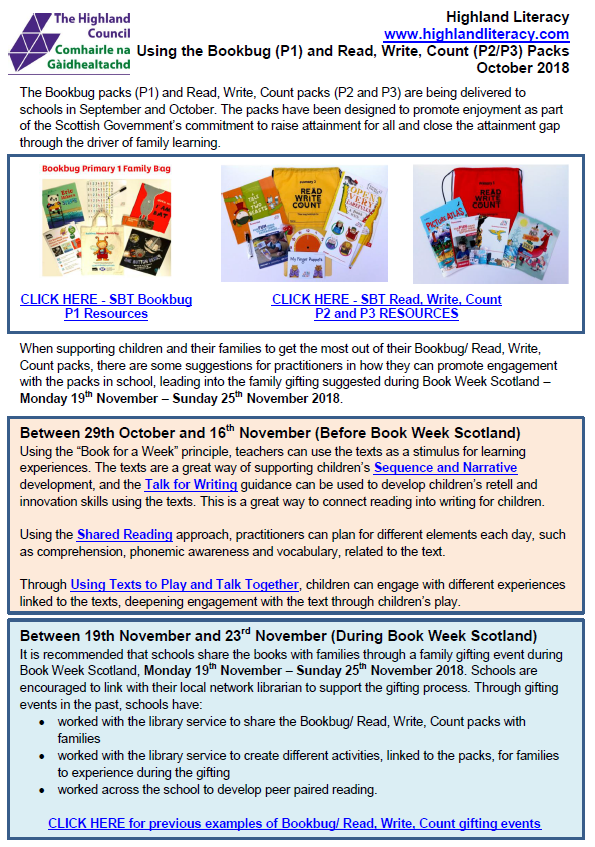
Using the Bookbug (P1) and Read, Write, Count (P2 and P3) Packs

The Bookbug packs (P1) and Read, Write, Count packs (P2 and P3) are being delivered to schools in September and October. When supporting children and their families to get the most out of their Bookbug/ Read, Write, Count packs, there are some suggestions for practitioners in how they can promote engagement with the packs in school, leading into the family gifting suggested during Book Week Scotland –  Monday 19th November – Sunday 25th November 2018.

CLICK HERE – Using the Bookbug (P1) and Read, Write, Count (P2 and P3) Packs

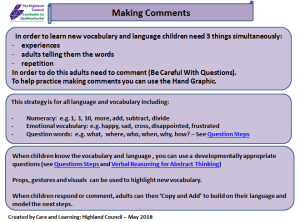
Balancing Questions with Comments

In the Words Up key messages, Be Careful With Questions, is one of the key messages which can support children’s language development through adult/child interaction.

Within the training practitioners explore the concept of balancing questions with comments to support interactions, enabling adults to model new language in context for children and provide the opportunity for children to respond to the comments which adults make.

As part of the Verbal Reasoning and Abstract Thinking resources, guidance has been created to support practitioners in ‘Making Comments‘.

CLICK HERE – Making Comments Guidance

Emerging Literacy 18/19 Network 1 Debrief – Pencil Control Skills

Over the summer, the Handwriting – Foundations and Building Blocks guidance on the blog was developed.  This includes information for early years practitioners and those in the early stages of school to support children’s movement and coordination skills through to early letter formation. When supporting children’s motor development, we recommend practitioners engage with this information and the resources included within.

Before children are explicitly taught how to form the letters of the alphabet, it is recommended that they develop the pencil control concepts which underpin handwriting. Teachers in early primary can assess children’s pencil control skills using the pencil control screen and plan for pencil control development using the ideas from the Pencil Control Concepts Toolkit.

At the first round of local networks in August and September we explored:

1.    The Pencil Control Screen and Accompanying Picture/ Resource Book
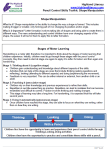
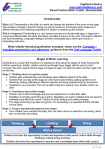
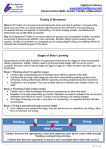
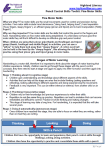
At the networks practitioners shared how and when they feel they may use the pencil control screen. The pencil control screen has been developed between education and occupational therapy to provide an overview for practitioners of children’s strengths and areas for development in the seven pencil control concepts of: shape formation, shape manipulation, directionality, fluidity of movement, fine motor skills, pressure control and pencil grip. Some possible ways in which practitioners identified they may use the pencil control screen are:

  • prior to providing opportunities for pencil control skill development in early primary, universally or with identified children following pre-handwriting observations, to help inform the planning of pencil control skill development through play and direct instruction;
  • once children have had opportunities to develop pencil control skills through play and direct instruction in early primary, universally or with identified children following observations of pencil control skills, to identify individual strengths and gaps to help inform planning of early letter formation;
  • with individual children who have had previous handwriting instruction who are displaying difficulties.

The seven sections of the screen can be used independently. Teachers can use their professional judgement as to how best to use the screen to inform their short and medium term planning.

2.    The Pencil Control Resource Toolkit
For each of the seven pencil control concepts there is a resource with suggested activities to support the development of the skill. This is done initially through thinking-looking-doing activities, and then further consolidated with a pencil. Practitioners identified different ways they may use the pencil control resource toolkit:

  • using the various activity suggestions for each of the pencil control skills to plan out their early handwriting programme universally for children prior to the formal instruction of letter formation;
  • creating a targeted early handwriting programme for individuals/ groups of children by identifying the areas of development through the use of the pencil control screen.

We will be further exploring and developing these resources during the 2018/2019 session through the networks. If you have any feedback on the resources, let us know by emailing emerging.literacy@highland.gov.uk.

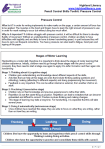
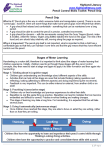
Pencil Control Skills Toolkit

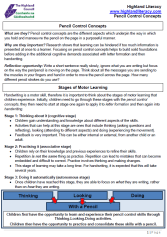
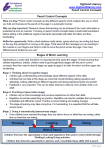
Pencil control concepts are the different aspects which underpin the way in which you hold and manoeuvre the pencil on the page in a purposeful manner. Before children are explicitly taught how to form the letters of the alphabet, it is recommended that they develop the pencil control concepts which underpin handwriting. Teachers in early primary can assess children’s pencil control skills using the pencil control screen and plan for pencil control development using the ideas from this Pencil Control Concepts Toolkit.

CLICK HERE – Pencil Control Screen

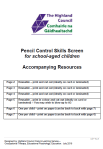
CLICK HERE – Pencil Control Screen Accompanying Picture Book

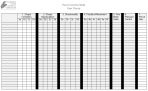
CLICK HERE – Pencil Control Screen Tracker

The pencil control screen can be used with school aged children to identify strengths and gaps in pencil control skills. It is recommended this is completed by the child’s class teacher to help inform their planning of learning, teaching and assessment in pencil control development.

The pencil control screen accompanying picture book should be used alongside the screen.

The pencil control screening tracker can be used to input the information from the pencil control screen at a cohort level, supporting practitioners’ planning of learning, teaching and assessment in pencil control development.

When planning for the learning, teaching and assessment of pencil control concepts, practitioners can use the pencil control toolkit ideas below.

CLICK HERE – Understanding Pencil Control Concepts

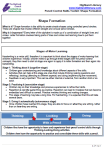
CLICK HERE – Shape Formation Resources CLICK HERE – Shape Manipulation Resources

CLICK HERE – Directionality Resources

CLICK HERE – Fluidity of Movement Resources CLICK HERE – Fine Motor Skills Resources CLICK HERE – Pressure Control Resources

CLICK HERE – Pencil Grip Resources

Emerging Literacy – Handwriting: Foundations and Building Blocks

The teaching of handwriting is built on children’s gross and fine motor development, and understanding of pencil control concepts. To support the teaching of early handwriting instruction the Emerging Literacy group have developed the Teaching Handwriting – Foundations and Building Blocks guidance. Access the guidance for links to relevant materials.

CLICK HERE – Teaching Handwriting – Foundations and Building Blocks