 Today we are pleased to share the progress of work across the Northern Alliance through Raising Attainment in Literacy, Language and Communication. The attached end of year report (July 2018) summarises the progress made in the Northern Alliance Emerging Literacy workstream as of July 2018. The summary (pgs. 2 – 4) details the key points and recommendations moving forward as below:
End of Year Report Summary – Key Points:
From the evaluations of Class Teachers and Senior Managers during the Emerging Literacy Networks in March 2018 (N=106) and the evaluations of the Sharing/Celebration Networks in May/June 2018 (N=287) it would be reasonable to summarise:
Through being part of the Emerging Literacy Workstream, the literacy, language and communication knowledge and understanding of teachers and senior managers is improving, impacting on how children develop early literacy skills.
- Prior to the pencil control input, less than one in six practitioners rated their knowledge and understanding of foundational handwriting skills as high. Following the input almost all practitioners reported having a high level of knowledge and understanding.
- Prior to the language development input on sequence and narrative skills, less than one in ten practitioners rated their knowledge and understanding of Sequence and Narrative skills as high. By the end of the network almost all practitioners reported having a high level of knowledge and understanding.
Through being part of the Emerging Literacy Workstream, teachers and senior managers have been able to track children’s progress in literacy, language and communication, tailoring learning and teaching to the needs of children.
Practitioners involved in the workstream have reported that they would benefit from further opportunities to collaborate on ‘Achievement of a Level’ to strengthen teacher judgement.
From the end of year evaluations of Class Teachers and Senior Mangers (N=287) during the Emerging Literacy Sharing/Celebration Networks in May/June 2018, it would be reasonable to summarise in schools which are taking a developmental approach to Emerging Literacy:
Children are demonstrating application of early foundational listening and talking, reading and writing skills.
The teaching and learning is matched to children’s stage of development; children are making progress and experiencing success which is developmentally appropriate.
Practitioners have reported that further collaborative support would be beneficial in order to enable schools to take a whole-school approach to Emerging Literacy.
From the data collection of a sample of Primary 1 pupils across the Northern Alliance (Sample size: N=1,932 in English Phonological Awareness; N=1,859 in Fine Motor Skills and N=1,859 in Pencil Control/ Pre-writing Skills) in May 2018, it would be reasonable to summarise:
Practitioners are paying attention to children’s strengths and gaps in their foundational skills, using the assess-plan-teach cycle to differentiate their teaching and learning to children’s needs. There has been clear progress in children’s foundational literacy development between September 2017 and May 2018.
By the end of Primary 1, almost all children have developed the earlier elements of Phonological Awareness which are foundations of the phonemic awareness which support effective reading and writing.
By the end of Primary 1, almost all children have developed the foundational skills which lead to efficient handwriting.
The “gaps” in children’s average Phonological Awareness scores are closing between children living in the most deprived areas compared with children living in the medium and least deprived areas. Children living in the most deprived areas made significantly more progress in phonological awareness than children living in the least deprived areas.
The average “gaps” in children’s tripod grasp and pencil control skills, which are foundations of handwriting, have been eliminated between children living in the most deprived areas compared with children living in the medium and least deprived areas. Children living in the most deprived areas made significantly more progress in tripod grasp and pencil control development than children living in the least deprived areas.
The March 2018 Interim Report summarised the analysis of the 2016/2017 ‘Achievement of CfE Levels’ data for Highland schools who were part of the Emerging Literacy workstream in 2016/2017. Analysis of the 2017/2018 data, with due regard to validity, will be undertaken during the 2018/2019 session.
End of Year Report – Future Recommendations:
Recommendation 1:
The evaluation of taking a developmental approach to Emerging Literacy should further investigate how the ongoing collaboration through networking is having an impact on practice and the outcomes that the changes in practice are having on children’s learning.
Recommendation 2:
Children’s progress in foundational literacy skills should continue to be tracked as an ongoing process by practitioners, using the information to inform the planning of learning, teaching and assessment. Practitioners should be supported to triangulate this information with observations and holistic assessment to further their understanding and teacher judgement of progress within and through the Curriculum for Excellence (CfE) Levels.
Recommendation 3:
The ongoing evaluations of practitioners should continue to be used to monitor the impact of individual aspects of professional learning as well as shaping the structure and content of subsequent networking, in person and online.
Recommendation 4:
Working in collaboration between local authorities/ health boards across the Northern Alliance and with colleagues in Education Scotland, case studies which detail how those involved in the workstream have taken a developmental approach to emerging literacy should be developed and shared. Case studies should focus on how the leadership of change and the impact on pedagogy better outcomes for children.
Recommendation 5:
The collaborative support for the 2018/2019 session should be driven by the elements identified in the 2017/2018 end of year evaluations. Practitioners should continue to be part of the development, testing and sharing of new resources.
Recommendation 6:
To enable sustainability of the approach, Lead Practitioners across the Northern Alliance should be supported throughout the 2018/2019 session to coordinate aspects of local networks of practice through peer education.

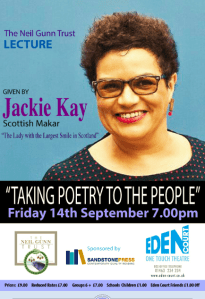 In 2016 Jackie Kay became the 3rd Scottish Makar. Accepting the appointment she said, “I hope to open up the conversations, the blethers, the arguments and celebrations that Scotland has with itself and with the rest of the world, using the voice of Poetry in its fine Scottish delivery.”






 HIGHLAND LITERACY