Developing Effective Writers

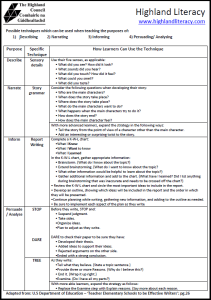
Click on the image below to download a list of techniques that can be used when teaching learners how to describe, narrate, inform, persuade and analyse.Capture

The table is taken from a guideline created by the Institute of Education Sciences, based on their four recommendations for developing effective writers:
1) Provide learners with the opportunity to write daily
2) Teach learners how to create a variety of genres
3) Teach sentence fluency, handwriting, spelling and keyboard skills
4) Create an engaged community of writers.

Capture2

Click the image above for the full practice guide.

Unlocking Creativity – Free CPD event

The Literacy Working Group have been working alongside the Creative Learning Network this session to strengthen the intrinsic links with Literacy and the Creative Arts. The following CPD, organised by the Creative Learning team at High Life Highland,  is an excellent opportunity to engage with the Creative Arts and give you ideas on how to bring texts to life in Literacy.

clnLooking Ahead . . .

Unlocking Creativity – Free CPD Opportunity

Wednesday 18th February, 2015
Eden Court, Inverness, 9:30am – 3:30pm
 

Creativity has a high profile in Scottish education and the development of creativity skills in learners is considered by many education experts and Scottish Government policy makers to be of prime importance. The Highland Creative Learning Network, a network of teaching staff and arts education professionals working across Highland, have recently received funding from Education Scotland to deliver ‘Unlocking Creativity’, a one day conference and training event designed to launch the 3-18: Creativity Across the Curriculum Review; to a wide range of arts and education specialists working across Highland. 

The CPD event will formally introduce creativity as a higher order thinking skill and as a cross-cutting theme across CfE. Led by Paul Collard, Chief Executive of Creativity, Culture and Education www.creativitycultureeducation.org the day will include key presentations followed by a number of workshop sessions that will explore the definitions of the 4 core creativity skills and how these can be unlocked through classroom learning;
–       Constructively Inquisitive
–       Open-minded
–       Able to harness imagination
–       Able to identify and solve problems
 
Attendees will take away new tools to unlock creativity skills across a range of subjects and the workshops will allow participants to discuss the context of creativity outside of the expressive arts subjects and how they relate to preparing young people for future life and industry.

There is also an opportunity for 10 attendees to access £175 for their class/school to begin embedding creativity in to their pupils learning and school improvement plans. By signing up to the Highland Creativity Challenge, the cash grant can be used as a sole spend or as match funding for a larger school project. The event is free to all Highland Council Education staff and catering and refreshments will be provided throughout the day. This event can be booked via the online Highland CPD service website but for more information contact amy.macleod@highlifehighland.com 

Thought Bombs . . .

Lisa Jane Ashes recently presented at the National Literacy Network in Dunblane as the keynote, presenting her work on embedding Literacy across Learning. She introduced the concept of Thought Bombs.

Capture

Thought Bombs – the resource is fairly simple; the plastic balls that you’d find in a child’s ball-pit, with a small hole cut out to make room for a slip of paper detailing a question, conversation starter or statement.

When posing learners a question, Thought Bombs can be used to sporadically add extra information to further guide or probe learners’ responses.

image-for-stim-1n8xex1

In this example, learners could be posed with the following question:
‘Our ship is sinking! Only one of us can survive . . . who would you pick?’

Learners would then discuss their opinions in small groups, justifying their responses based on the information that they know about each person.

After learners have been given a few minutes to discuss their thoughts, you could place Thought Bombs with their groups that provide more information or further questions, e.g.
– Marni is a convicted criminal and has spent time in a Young Offender Institution
– Robert has hunting skills that allow him to survive in the wild
– Roberta is an MI5 agent
– Marni is Roberta’s daughter
– Roberta is Robert’s daughter
– Robert does charity work at his local food bank
– What skills would Marni have to survive?
– What assets might Roberta have to help her live longer?
– How do you think Robert would survive?
– What crime do you think Marni convicted?
– Create a survival plan for your chosen survivor
– What has caused the ship to sink?

CLICK HERE to download the questions above to use in Thought Bombs.

The SSLN (Scottish Summary of Literacy and Numeracy) Professional Learning Resource includes a great resource – Lost – that could be used to facilitate the use of Thought Bombs.

CLICK HERE – SSLN LOST

When analysing a text, use Thought Bombs to discuss character, setting, plot and themes.

Thinking of using Thought Bombs to promote thinking and develop listening and talking skills in your classroom – leave us a comment to let us know how you plan to develop the resource?

Teaching Trailers

FE

The Film Education website is an excellent resource to use when teaching digital texts and delivering Media Literacy.

One of their resources is Teaching Trailers – a resource that includes lesson plans which supports the teaching of using film trailers as a mode of text.

Primary
CLICK HERE – Lesson Plans
CLICK HERE – Schemes of Work

Secondary
CLICK HERE – Trailers
CLICK HERE – Teachers’ Notes