Writing a Literacy Policy in the Primary School – EXAMPLE

Capture

In our earlier post Writing a Literacy Policy in Highland Schools we provided guidance and a template for Highland Primary Schools to support the creation of a Literacy Policy.

Following this we have now created an example policy based on these guidelines. This is aimed to show what a Literacy Policy may look like in a Primary School.

CLICK HERE – Writing a Literacy Policy in the Primary School EXAMPLE

Inspiring Writing Using artwork

Pieces of art, in particular portraits, can be used as a vehicle for discussion which can contribute to creating a piece of text.JB

An exciting interdisciplinary learning opportunity is visiting the Highlands. Portrait artist John Byrne’s portrait exhbition is in residence between the 1st and 29th of November in Inverness Museum and Art Gallery.

The Creative Learning Leader, Amy Macleod, at High Life Highland has announced an exciting opportunity for learners in Highland schools. With a 75% travel subsidy incentive (must be agreed with Amy Macleod in advance) for schools to visit Byrne’s work, it’s a great opportunity to educate learners about a Scottish artist.

Schools who benefit from visiting the exhibition are asked to submit pieces of writing for a creative writing text called the “Highland Book of Byrne”. This is an excellent opportunity to provide purpose and audience when creating texts across Second – Fourth Level CfE and the Senior Phase.

For information about the exhibition:
CLICK HERE – John Byrne Sitting Ducks

For more information, please email: amy.macleod@highlifehighland.com

READ Strategies

Capture

When delivering a reading lesson we teach learners a number of different skills. These skills may be developed before, during or after reading a text.

A tool has been created to help practitioners define some of these strategies which fall under four broad headings:

R – Reading Fluency
E – Enabling Accuracy
A – Ambitious Vocabulary
D – Developing Comprehension

The first page provides an overview of these skills. The later three pages of the document contain video links (accessed by clicking the images) which provide you with an overview of the strategy, and ideas around how to embed this in your classroom.

This can be used in conjunction with your current reading programme.

CLICK HERE – READ Strategies

Structuring Your Literacy Programme

Capture

When shaping our “Literacy Week” in our classrooms we encompass a wide variety of skills through reading, writing and listening and talking activities.

We’ve looked at putting a structure together which could encompass these aspects into Literacy lessons which allow practitioners to engage with all learners during the literacy session whilst developing a multitude of skills.

We’re very interested in feedback on these guidelines.

CLICK HERE Highland Literacy – Structuring your Literacy Programme

Literacy Circles

Capture

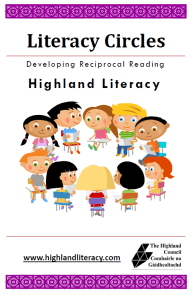
Literacy Circles is an approach which develops Reciprocal Reading.

Reciprocal reading is a well-researched method used to develop learners’ reading skills, promote higher order thinking, develop listening and talking, and ensure access to the curriculum for all learners. Studies have also demonstrated that learners transfer their learning into other contexts. Reciprocal reading is just one in a number of strategies which can be used when learners are reading and analysing texts.

We have developed guidelines to help you establish Literacy Circles in your classroom.

When printing these guidelines please select “Flip on the Short Edge” under “2 Sided Printing” in your printer’s settings. This will print a booklet using three sheets of A4.

CLICK HERE Highland Literacy – Literacy Circles

Reading Between the Lines

Capture

A new resource has been created and added to ‘The Literacy Toolkit’ section of our blog.

Reading Between the Lines is a PowerPoint which can be used to explore the research and views around developing thinking skills in reading comprehension, and to generate professional dialogue and action relating to this with a view to improving experiences for the young people in school.

CLICK HERE – Reading Between the Lines