21st Century Literacy!

Access to an iPad? If so, this post is for you…

This slideshow requires JavaScript.

Whilst we live in an age of multi-media, where visuals and audio seem to be dominant in every day life, text is not going away! Supporting literacy, whilst encompassing technological developments, the use of an iPad can engage learners demonstrating that literacy is FUN!

Teach Mama wrote a blog post in December suggesting iPad apps which can be used within the classroom, and at home to enhance literacy learning. Typing ‘literacy’ into the App Store, we’ve found a few of our own which we’d also like to recommend. The following apps are currently FREE in the App Store:

Word Mover – Learners are able to build poems and prose using sequences of common words, in addition to expanding their vocabulary with unfamiliar words.

Wordball – A resource ideal for 1st/2nd level of CfE in which learners can create words against the clock from the letters given.

Fun Rhyming – The clue is in the title- using phonic knowledge, learners identify words using the given sound.

SB Spelling – A great spelling resource- learners can input their own spelling list; using the principles of ‘Look, Say, Cover, Write, Check’ they can revise their spelling words, using an interactive and engaging approach to learning.

Treasure Hunt – An interactive game in which learners use their literacy skills to solve problems.

Build A Story – Wanting to engage learners in writing? This resource is an interactive method of creating texts using visual stimuli such as images/animations, in conjunction with written text.

iBooks – Texts can be downloaded for Reading for Enjoyment. There are many ‘read aloud’ texts also available for free within the App Store- type ‘literacy’ to explore. Kindle- is a similar resource you may want to check out.

We’d like to know your thoughts of using technology to support literacy both within the classroom, and at home.

Working towards creativity…

This slideshow requires JavaScript.

Following on from the previous post about creativity, click below for a Bloom’s taxonomy resource which can be used to develop thinking in the classroom.
Bloom-Question-Fans

Visit the blog below- they’ve also suggested ways in which Bloom’s taxonomy can be used in the classroom:
http://thoughtweavers.wordpress.com/2011/05/22/using-blooms-taxonomy-in-the-classroom/

Teaching Thinking…

This slideshow requires JavaScript.

Some great ways of checking that our planned literacy experiences are focused on thinking about learning… I loved the idea of the Bloom’s Buttons that you’ll see in the slideshow!  If you want to know more about these then leave a comment and I’ll let you know how to get hold of them!

Big Writing- What is it?

Image

‘Big Writing’ is a strategy used to teach writing; developed in England by Ros Wilson, its core principle is to improve the writing standards of our learners.

The purpose NOT to teach the features of fiction and non-fiction text, but to develop  the confidence of our learners in using ambitious vocabulary, varied connectives, powerful openers and sophisticated punctuation to produce effective pieces of writing.

Whilst using Big Writing I have found that:

  • Learners thoroughly enjoy VCOP games and activities (Vocabulary/Connectives/Openers/Punctuation)
  • The interactive software, which can be purchased through Andrell Education, supports practitioners when planning lessons
  • The ‘Scottish Criterion Scale’, used to assess pieces of writing, gives you a shared standard in which learners can work towards
  • Moderation with colleagues is KEY to ensure that we are assessing pieces accurately and with confidence, due to some subjective criteria in the scale
  • A wealth of resources are available to support Big Writing, however they are not housed in one particular place

Visit the Andrell Education website below to find out more:
http://www.andrelleducation.co.uk/about-us/what-big-writing-is/

Are you using Big Writing? If so, we’d love to hear your experiences of using the strategy.

Reading Recovery

readingowlAn area which we wish to develop within the Highland Literacy Working Group is Reading Recovery. We’re looking for Reading Recovery schemes which have proved successful within schools. 

‘Speeder Reader’ is one scheme which has been piloted in Highland schools.

What recovery schemes are out there, and how successful are they?

Answers on a postcard… or even better, as a comment on this blogpost!

paper tubes

I know this image has nothing much to do with literacy…but when looking at the Jolly Learning Facebook page I got distracted by it and loved the idea!  Cut up and squashed toilet rolls never looked so good!  If you click on the image you’ll find yourself at Jolly Learning’s page and while there are lots of great literacy ideas posted there you’ll also find some really fun activities to do just because they’re FUN! Thanks Fiona at Raigmore for sharing this!

Reading Strategies

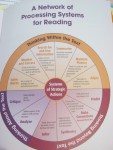
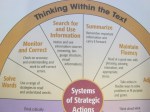
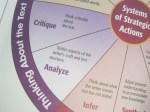
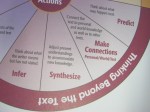
These images come from the book, ‘The Continuum of Literacy Learning’ which is a good resource! We do a lot of this already but I like the way it’s presented- nice and simple!   If you know of other resources that focus on teaching reading strategies then please let us know and we can share them here.