Author Archives: Mr Cook

‘William’s Doll’ – Lesson Plan

During December we will be sharing the lesson plans published by Highland Council’s Equalities Improvement Group and LGBTI+ sub-group to support the development of Equality and Diversity across the curriculum. 18 picture books have been selected; for each picture book there have been lessons created for Early – Fourth Levels (Curriculum for Excellence) driven by the Literacy and English and Health and Wellbeing Experiences and Outcomes.

Today’s Lesson: ‘William’s Doll’ – Charlotte Zolotow

More than anything, William wants a doll. ‘William’s Doll’ was published in 1972 and was one of the first picture books to deal with gender stereotypes.

To support the health and wellbeing of our children and young people we need to challenge gender stereotypes. ‘William’s Doll’ is a brilliant text which does just that.

CLICK HERE – ‘William’s Doll’ LESSON PLAN

Kindly created and shared by the young people and adults within the Millburn ASG Equality and Diversity Working Group and the Highland Council’s LGBTI+ sub-group of the Care and Learning Equalities Improvement Group.

‘Red: A Crayon’s Story’ – Lesson Plan

During December we will be sharing the lesson plans published by Highland Council’s Equalities Improvement Group and LGBTI+ sub-group to support the development of Equality and Diversity across the curriculum. 18 picture books have been selected; for each picture book there have been lessons created for Early – Fourth Levels (Curriculum for Excellence) driven by the Literacy and English and Health and Wellbeing Experiences and Outcomes.

Today’s Lesson: ‘Red – A Crayon’s Story’ – Michael Hall

Funny, insightful, and colorful, Red: A Crayon’s Story, by Michael Hall, is about being true to your inner self and following your own path despite obstacles that may come your way.

‘Red – A Crayon’s Story’ is a great book which can be used to explore the themes of: our unique identity, celebrating difference and the difference between your inner self and your appearance.

CLICK HERE – ‘Red: A Crayon’s Story’ LESSON PLAN

Kindly created and shared by the young people and adults within the Millburn ASG Equality and Diversity Working Group and the Highland Council’s LGBTI+ sub-group of the Care and Learning Equalities Improvement Group.
Northern Alliance – Emerging Literacy – YAMMER site

The Northern Alliance aims to improve the outcomes for children and young people. Through the working partnerships within and across local authorities and within and across health boards, effective collaboration is core to the improvements across the Northern Alliance.

As part of the Raising Attainment in Literacy, Language and Communication workstream, face to face collaboration is promoted through Northern Alliance events and local authority networks. To enhance the ongoing collaboration to improve outcomes for children and young people, the Northern Alliance also uses digital collaboration through the use of Yammer.

Yammer is a platform which promotes collaboration, building connections between people. The Yammer education network within Scotland is accessed through Glow. There is also a Yammer app which can be downloaded for smartphones and tablets. The Raising Attainment in Literacy, Language and Communication workstream aim to use Yammer across the Northern Alliance to:
 strengthen the collaboration between practitioners
 share resources
 share impact on practice and outcomes for children
 discuss queries and questions.

CLICK HERE: Northern Alliance – RAILLC – YAMMER INFORMATION

Developing Political Literacy – Education Scotland

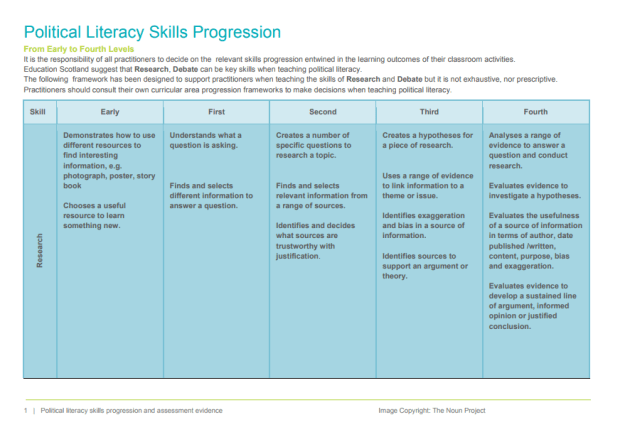
Education Scotland have released a suite of new resources to support the development of Political Literacy on the National Improvement Hub.

Young people need to understand democratic processes, and to know how the people who we elect, and who represent us at local councils and parliaments, make important decisions that affect almost every aspect of our daily lives. The opportunity to develop skills, knowledge and understanding in political literacy can be found within every curricular area.

This resource supports practitioners, schools and community settings to reflect on how well they build capacity in learners to use their voice, participate and contribute to decision-making processes that are real and meaningful.​

CLICK HERE – Education Scotland Political Literacy

The Political Literacy skills progression can be used to support the development of the Literacy and English Experiences and Outcomes through the theme of political literacy, as well as supporting the development of Key Assessment Tasks within the context of political literacy.


Taking a Whole School Approach to Emerging Literacy – Audit Tool

As part of ongoing school self evaluation, linked to How Good Is Our School 4 (HGIOS4) and How Good Is Our Early Learning and Childcare (HGIOELC), an audit tool to support schools in taking a whole school approach to Emerging Literacy has been created and shared through the Emerging Literacy Networks.

The Emerging Literacy Audit Tool is linked to the five Quality Indicators (Q.Is) within the Emerging Literacy improvement plan. The tool provides statements of practice which support schools in taking a whole school approach to Emerging Literacy. Schools are encouraged to firstly use pg.1 to audit their progress against the statements linked to each of the Q.Is.

Following this, schools can use pg.2 to pg.6 to identify their next steps as part of their ongoing engagement with taking a developmental approach to Emerging Literacy; the statements within the audit supporting the action plan within the School Improvement Plan.

CLICK HERE – Emerging Literacy Audit Tool

Authors Live – Phil Earle

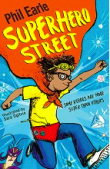
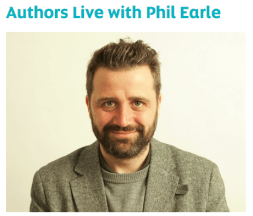
As part of Book Week Scotland on Tuesday 28th November 2017, 11am – 11.40am, the Scottish Book Trust are hosting children’s author Phil Earle, much loved author of the ‘Storey Street‘ books, as part of Authors Live for P4 – S1 pupils.

Authors Live sessions can be watched live, or can be accessed in the Watch on Demand section of the Scottish Book Trust website.

CLICK HERE – SIGN UP AUTHORS LIVE: PHIL EARLE

Date: Tuesday 28th November 2017
Time: 11am – 11.40am
Target Audience: P4 – S1

Please note that the link to watch is emailed to you manually by one of the Scottish Book Trust team. As this is not an automatic process, please sign up to watch as soon as you can so that they can get your link to you in plenty of time.

P1 Bookbug Packs – Blanks Language Questions

P1-3 Teachers – Have you organised a Bookbug/ Read, Write, Count gifting with your local network librarian? If not, get in contact ahead of Book Week Scotland next week to see how you can work collaboratively.

At the last round of Emerging Literacy Networks in November we explored developmentally appropriate language and questioning through the Blanks Language Scheme. As part of the Literacy Toolkit, you can access the Asking the Right Questions at the Right Time PowerPoint which supports practitioner understanding of concrete to abstract language.
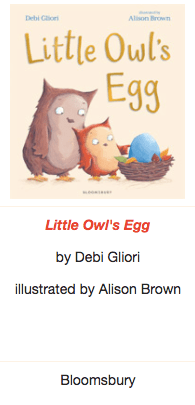
Within the networks, practitioners created a bank of Level 1 – Level 4 questions to use when developing dialogic reading using the Primary 1 Bookbug packs. These can be downloaded by clicking the images and hyperlinks below:

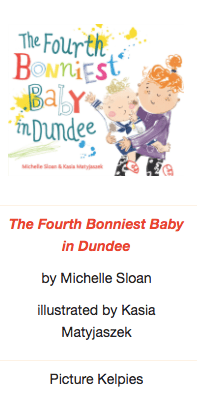
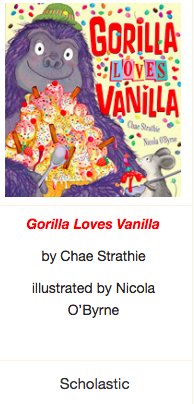
CLICK HERE – Blanks Language: Little Owl’s Egg  CLICK HERE – Blanks Language: The Fourth Bonniest Baby in Dundee  CLICK HERE – Blanks Language: Gorilla Loves Vanilla

P1 Teachers: Register your class to vote in the Bookbug Picture Book Prize ahead of Book Week Scotland next week. Once you have used the books in your classroom to support your learning and teaching, and taken part in your class Bookbug gifting, you class are to vote for their favourite by Friday 8th December 2017. CLICK HERE – REGISTER TO VOTE

Nourish – Book Week Scotland

This year’s Book Week Scotland theme is ‘Nourish’ . . . a theme all about food!

Get your children and young people and their families involved in this year’s theme of ‘Nourish’. This is an excellent way to develop both Literacy and English and Health and Wellbeing through family learning.

Food can evoke memories, connect us with others, present difficult choices or simply set us up for the day – it can challenge and inspire us and offer nourishment beyond what’s on the plate.

Writing About Food
This learning resource has been designed to support the development of food education through the Nourish campaign. This could be developed as an interdisciplinary context through health and wellbeing and literacy.

CLICK HERE – Writing About Food

Northern Alliance: Raising Attainment in Literacy, Language and Communication – Interim Report (November 2017)

Today we are pleased to share the progress of the Northern Alliance Rasising Attainment in Literacy, Language and Communication workstream. The interim report (November 2017) summarises the progress made in the Northern Alliance Raising Attainment in Literacy, Language and Communication workstream as of November 2017.

Interim Report Summary – Key Points:

  • The Raising Attainment in Literacy, Language and Communication workstream is providing direct support to practitioners in 47% of primary schools across the Northern Alliance during its second year (2017/2018).

From the data collection of a sample of Primary 1 pupils across the Northern Alliance in September 2017, it would be reasonable to summarise:

  • On Primary 1 entry developmental gaps in foundational reading and writing skills are to be expected. These individual differences arise from natural variation in development as well as from environmental factors. The purpose of the emerging literacy approach is to enable teachers easily to adapt teaching and learning to the expected developmental variations.
  • On Primary 1 entry the particular pattern of gaps is different for each individual child. At a whole class level, each class will have different patterns, and there will be year-on-year differences in the same school. There are, however, areas of foundational reading and writing skills in which gaps are more and less prominent. It would not be developmentally expected for all children to enter Primary 1 with secure foundational reading and writing skills. Taking a developmental approach to Emerging Literacy therefore supports practitioners to identify said strengths and gaps to match teaching and learning to the needs of each and every child.
    • On Primary 1 entry less than one in ten (7%) of Primary 1 children had fully secure phoneme discrimination, phoneme segmentation and phoneme blending skills, the phonemic awareness skills which underpin reading and spelling words using phonics.
    • On Primary 1 entry less than four in five Primary 1 children (79%) had secure pencil control skills which underpin the writing of letters.
  • On Primary 1 entry there is evidence of developmental gaps linked to deprivation.
  • On Primary 1 entry there was a gap of 1.1 in the average scores (out of a possible 12) for Phonological Awareness between Primary 1 children living in the most deprived areas (SIMD 1-3) [N=4.3] compared with those living in the least deprived areas (SIMD 8-10) [N=5.4].
  • On Primary 1 entry there was a 10% difference in the percentage of Primary 1 children, linked to deprivation, who had a secure tripod grasp, a skill foundational to the manipulation of writing implements. Of the P1 children assessed 78% of those children living in the most deprived (SIMD 1-3) areas and 88% of children living in the least deprived (SIMD 8-10) areas had a secure tripod grasp.

Interim Report Summary – Future Recommendations:

  1. As part of the national arrangements for regional collaboration the Northern Alliance Raising Attainment in Literacy, Language and Communication workstream should detail the action plan moving forward within the Northern Alliance Improvement Plan (due to be published in early 2018).
  2. The successful model of collaboration developed within the Northern Alliance Raising Attainment in Literacy, Language and Communication workstream, and detailed within this report, should be shared with the Lead Officers of the Northern Alliance workstreams.
  3. The data published within this report should be used as a basis to monitor ongoing progress and performance across the Northern Alliance. At school level practitioners should continue to use the data to inform learning, teaching and assessment to raise attainment and close the poverty related gap.
  4. The Northern Alliance Raising Attainment in Literacy, Language and Communication workstream has been designed by practitioners for practitioners, with support from a wide range of Allied Health Professionals (AHPs) and other specialists. The collaboration within and between local authorities and health boards should continue to be developed to enable self-evaluation at practitioner level to inform the core support at regional level. AHP services may find it helpful to monitor the impact of participating in the workstream on service delivery against the Ready to Act.
  5. The learning from the Northern Alliance Raising Attainment in Literacy, Language and Communication workstream should continue to be shared at national level to support ongoing improvement for Scotland’s children and young people.

CLICK HERE: Northern Alliance – RAILLC – Interim Report – November 2017_FINAL

Pre-Teaching Vocabulary: Resource Cards

Thanks to Laura McGinlay, PEF Literacy Officer, for sharing this resource which she has created.

Highland recommends using Pip St.John – Pre-Teaching Vocabulary as a whole-school approach to vocabulary instruction.

PIPSTJOHN

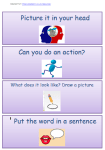
To support you in using the Pre-Teaching Vocabulary posters, the following resources have been created, available to download to use as part of vocabulary instruction and vocabulary displays.

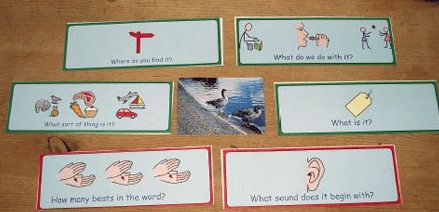
Click the links below for large versions of the Step 1, 2 and 3 cards which can be downloaded and used when using Pre-Teaching Vocabulary to teach new language:

 CLICK HERE: PTV – Green

 CLICK HERE: PTV – Red CLICK HERE: PTV – Blue