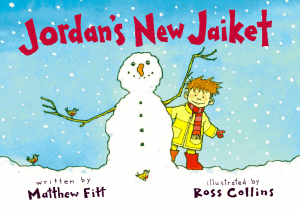
Jordan’s New Jaiket is a resource from Education Scotland to support the teaching of Scots. The author, Matthew Fitt, also administers the Scots Hoose website.
CLICK HERE – Jordan’s New Jaiket
CLICK HERE – Resources for Scots

Jordan’s New Jaiket is a resource from Education Scotland to support the teaching of Scots. The author, Matthew Fitt, also administers the Scots Hoose website.
CLICK HERE – Jordan’s New Jaiket
CLICK HERE – Resources for Scots
Lisa Jane Ashes recently presented at the National Literacy Network in Dunblane as the keynote, presenting her work on embedding Literacy across Learning. She introduced the concept of Thought Bombs.

Thought Bombs – the resource is fairly simple; the plastic balls that you’d find in a child’s ball-pit, with a small hole cut out to make room for a slip of paper detailing a question, conversation starter or statement.
When posing learners a question, Thought Bombs can be used to sporadically add extra information to further guide or probe learners’ responses.

In this example, learners could be posed with the following question:
‘Our ship is sinking! Only one of us can survive . . . who would you pick?’
Learners would then discuss their opinions in small groups, justifying their responses based on the information that they know about each person.
After learners have been given a few minutes to discuss their thoughts, you could place Thought Bombs with their groups that provide more information or further questions, e.g.
– Marni is a convicted criminal and has spent time in a Young Offender Institution
– Robert has hunting skills that allow him to survive in the wild
– Roberta is an MI5 agent
– Marni is Roberta’s daughter
– Roberta is Robert’s daughter
– Robert does charity work at his local food bank
– What skills would Marni have to survive?
– What assets might Roberta have to help her live longer?
– How do you think Robert would survive?
– What crime do you think Marni convicted?
– Create a survival plan for your chosen survivor
– What has caused the ship to sink?
CLICK HERE to download the questions above to use in Thought Bombs.
The SSLN (Scottish Summary of Literacy and Numeracy) Professional Learning Resource includes a great resource – Lost – that could be used to facilitate the use of Thought Bombs.
When analysing a text, use Thought Bombs to discuss character, setting, plot and themes.
Thinking of using Thought Bombs to promote thinking and develop listening and talking skills in your classroom – leave us a comment to let us know how you plan to develop the resource?

The Film Education website is an excellent resource to use when teaching digital texts and delivering Media Literacy.
One of their resources is Teaching Trailers – a resource that includes lesson plans which supports the teaching of using film trailers as a mode of text.
Primary
CLICK HERE – Lesson Plans
CLICK HERE – Schemes of Work
Secondary
CLICK HERE – Trailers
CLICK HERE – Teachers’ Notes
A national campaign, ‘Read on, Get on‘, to get children reading well by 11 years old has been launched by a group of organisations and businesses. A report has been published which sets out the four main action points of the campaign which include prioritising the development of communication skills in the early years of a child’s life, and supporting families to help their children read.
CLICK HERE – ‘Read on, Get on’ Scotland
Watch the short video below to hear and see the powerful messages:
‘Read on, Get on’ have created a list of ten Top Tips to get children reading. This may be something you want to share with parents/carers through your school website/blog.


When teaching learners oral presentation skills we aim to empower them with the ability to confidently deliver their subject matter. A learner’s fluency can often be hindered through:
Hesitation – an unintended pause for more than two seconds
Elision – slurring sounds together e.g. going to = gonna
False Start – beginning with an utterance/extended pause
Filler – exchanging words for sounds e.g. emm, uhh, ahhh
Provide learners with opportunities to avoid using H.E.F.F to develop their fluency when presenting.
Give The Spoken Language game a go in your classroom – how long can your learners talk for on a subject without breaking H.E.F.F?
I recommend saving this one to your Internet Favourites for after the Christmas break.
I stumbled across this website which is a gem of a find, aiming to support the writing process. Lend me your Literacy – Picture of the Day is a resource which aims to encourage young people to write creatively.
Each day they publish a picture alongside a possible lesson stimulus; spelling, punctuation and grammar activities; and genre feedback check-lists.
I love this picture from last week . . .

Roy the Zebra is an excellent website that can be used to support the teaching of reading and language skills.
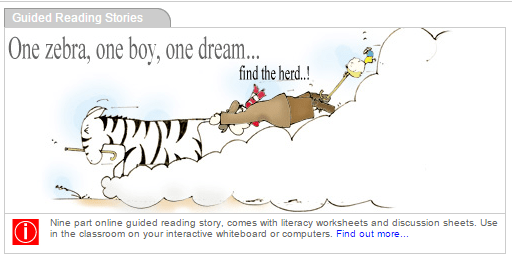
The Guided Reading Stories section is a nine part story that can be used with lower/middle Primary and includes discussion sheets and resources which can support the use of language techniques, e.g. sentence structure.
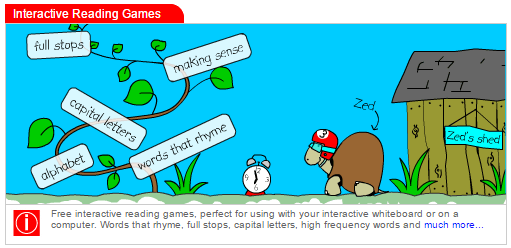
The Interactive Reading Games can be used in the lower/middle Primary to support the teaching of phonics, spelling and sentence structure. Although designed for the earlier stages of primary, these games may be appropriate in the upper Primary/ lower Secondary to consolidate technical accuracy when creating texts or when taking part in paired reading and writing tasks.
As it’s the last week of term, and we’re in the Christmas spirit, why not use Christmas adverts for a compare and contrast lesson this week . . .

CLICK HERE – Christmas Adverts 2014 (The Independent)
A lesson suggestion . . . appropriate for all Levels through the BGE with differentiated levels of questioning and independence.
Christmas Adverts – compare and contrast
Significant Aspects of Learning – Reading
Learning Outcome – I am learning how to compare the features used in two texts.
Step 1: Watch the Sainsbury’s Official Christmas Advert 2014
Step 2: Use the Viewing Media questions to facilitate the discussion around the text, selecting the main ideas, emotions evoked and features used.
Step 3: Watch the John Lewis Official Christmas Advert 2014
Step 4: Use the Viewing Media questions to facilitate the discussion around the text, selecting the main ideas, emotions evoked and features used.
Step 5: Use the Text Structure – Compare and contrast hand-out to indicate the features pertinent to each of individual adverts and the features that both adverts possess.
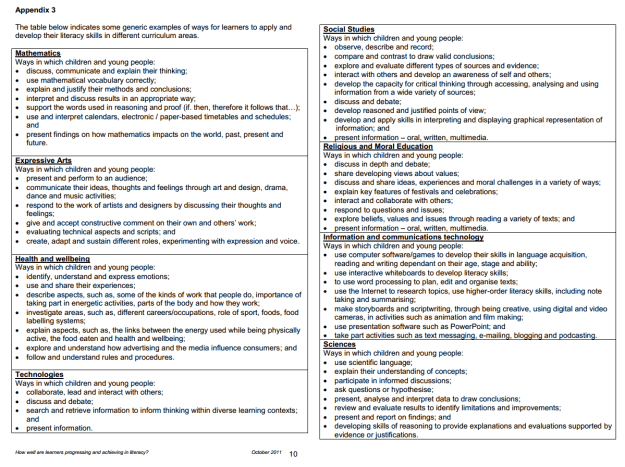
The Education Scotland document How well are learners progressing and achieving in literacy? provides, in Appendix 3, a list of generic examples of how to promote Literacy across Learning within subject specific curriculum areas – a useful reference tool.
Big Brown Bear has links to ten free online software resources that can be used to teach spelling, phonics, and language techniques.
A favourite is the Matching Suffixes game which is great for teaching word roots and suffixes. The Spelling and Beyond . . . PowerPoint from The Literacy Toolkit can be used to support professional development around the teaching of metalinguistics.
 HIGHLAND LITERACY