Mini Sagas – YoungWriters

TimeTravellingTales

A great Interdisciplinary Context looking at Literacy and Social Studies.

This year YoungWriters have set the theme of their 7 – 11 year old Mini Saga Creative Writing Competition as ‘Time Travelling Tales’.

Let your pupils be inspired with history or intrigued with the future before challenging them to write a mini saga – a story in just 100 words!

The competition has a closing date of Thursday 24th December 2015.

CLICK HERE – ‘Time Travelling Tales’ Information

SC

This year’s 11 – 18 theme is ‘Spine Chillers’. In the 11 – 18 pack you will find a lesson plan and downloadable materials to get the children and young people you work with involved. The Spine Chillers competition also has a closing date of Thursday 24th December 2015.

CLICK HERE – ‘Spine Chillers’ Information

Reading for Pleasure – Education Scotland

indpEducation Scotland have started a new online community for Literacy and English. Their current topic is ‘Reading for Pleasure’ which you can take part in between now and the third of December.

CLICK HERE – Education Scotland ‘Reading for Pleasure’

Some questions to consider…

  • Do you recognise the benefits of reading for pleasure in the learners that you work with?
  • Rewards and motivation – Do reward schemes have a positive or negative impact on young readers’ motivation?
  • Have cultural changes and technological advances changed children’s attitudes to reading? Are there ways to work with this?

CLICK HERE TO JOIN THE DISCUSSION

Check out the following Highland Resources:
CLICK HERE – Independent Reading
CLICK HERE – HLP Reading for Enjoyment

Creative Writing – Scottish Book Trust

The Scottish Book Trust have published a CPD resource which can be used by practitioners to support the teaching of Creative Writing. Check out the information below:

cpdtoolkits_howtoteachcw_video1_thumb

“Join author and illustrator Nick Hesketh in this highly practical video series, packed full of suggestions to get your pupils writing!

Ostensibly aimed at reluctant readers and writers, these videos are full of tips and classroom strategies which can often be applied across a wide range of age and ability. Many of them are accompanied by downloadable guides and classroom resources to help you make the most of the activities mentioned in the video.

As Nick points out, “Creative writing underpins so many activities, it’s difficult to know where to stop.” We hope that you and your pupils leave these videos feeling energised and fully convinced of the rewards that lie in creative writing!”

Click the image above to access the resource,

Pre-Teaching Vocabulary

PipStJohn

Following our post on Pre-Teaching Vocabulary and publishing our Building Vocabulary for Better Literacy resource, a group of practitioners have identified that it would be useful to download the posters from the Pip St. John, Pre-Teaching Vocabulary resource directly on the blog.

Click the links below to access the posters:
PTV – Step 1 – How we learn new words wheel
PTV – Step 2 – How we learn new words wheel
PTV – Step 3 – How we learn new words wheel

Paired Reading

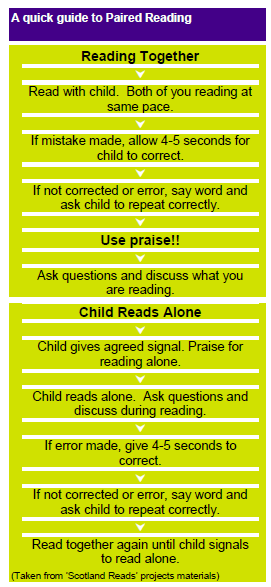
CaptureWanting to train pupils in your school to be Literacy Mentors or Reading Buddies?

Inverclyde Council have developed a great guide (based on the Scotland Reads model) on how to develop Paired Reading within your school. This is so much more than two pupils sharing a book together (which is another great opportunity to develop the modelling skills required to read with fluency and expression!).

Paired Reading requires a mentor/mentee relationship to be developed amongst peers (or child and adult), where the mentor has a clear role in supporting the mentee with their reading development.

Find out more by accessing the links below:

CLICK HERE – Paired Reading Leaflet

CLICK HERE – Scotland Reads: Education Scotland

Primary Literacy Briefing

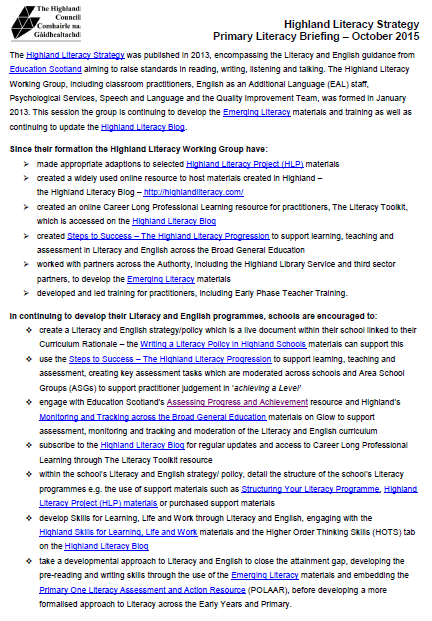
The Primary Literacy Briefing below was sent to all Head Teachers within the Local Authority this week. The document has been developed to support schools in further developing their Literacy programmes during the 2015/2016 session.

PLBOCT15

CLICK HERE Primary Literacy Briefing – October 2015

The blog will continue to be updated over the 2015/2016 session, recommending resources, sharing Highland developments and exploring National materials.

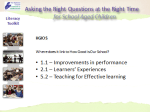
Asking the Right Questions at the Right Time

QUESTION

A new resource has been created and added to ‘The Literacy Toolkit’ section of our blog.

Asking the Right Questions at the Right Time – The objective of this PPT is to explore what types of questions we ask, the developmental nature of verbal reasoning skills and how to adapt our language to achieve improved learning outcomes for children and young people. It is written for education staff working with primary and secondary school ages.

CLICK HERE – Asking the Right Questions at the Right Time

Studyladder

Check out Studyladder – a fantastic esource from Australia that can be used by learners to reinforce concepts in literacy. I particularly like the reading comprehension exercises. Accounts can be set up for individuals and learning snippets can be assigned for completion online in class or at home.

Capture

The resource also has materials that can be used across different areas of the curriculum. Click the image above to access Studyladder.

Storycrafting – Deep Listening

Inspired by a piece of work that one of our Highland Primary Probationer teachers carried out last session, I was itching to read more about Storycrafting.

A method developed in Finland, Storycrafting allows a learner to tell a story, be listened to, be retold their story and make reflective changes based on what they hear back. once-upon-262x300

Click the hyperlink above to access a website with information about Storycrafting. Click the image above for a short journal article about Storycrafting in action.

In Storycrafting you:

  • Allow a learner to tell a story of their choice to a partner/adult
  • The learner/adult who is listening to the story should scribe it word for word
  • The listener should then retell the story back to the story teller as it has been written
  • The storyteller can then make changes based on what they’ve heard.

Storycrafting is a great method which can be used in the classroom to develop literacy through social interaction, or expanded to partnership working across classrooms and schools as a Global Citizenship project.

CLICK HERE: Your Mango, My Mango, Our Mango – this is a resource which can be used to support the Storycrafting methodology using through the theme of Global Citizenship.