‘Read on, Get on’

A national campaign, ‘Read on, Get on, to get children reading well by 11 years old has been launched by a group of organisations and businesses. A report has been published which sets out the four main action points of the campaign which include prioritising the development of communication skills in the early years of a child’s life, and supporting families to help their children read.
CLICK HERE – ‘Read on, Get on’ Scotland

Watch the short video below to hear and see the powerful messages:

‘Read on, Get on’ have created a list of ten Top Tips to get children reading. This may be something you want to share with parents/carers through your school website/blog.

ROGO

CLICK HERE – ‘Read on, Get on’ TOP TIPS

Spoken Language Game

talk

When teaching learners oral presentation skills we aim to empower them with the ability to confidently deliver their subject matter. A learner’s fluency can often be hindered through:

Hesitation – an unintended pause for more than two seconds
Elision – slurring sounds together e.g. going to = gonna
False Start – beginning with an utterance/extended pause
Filler – exchanging words for sounds e.g. emm, uhh, ahhh

Provide learners with opportunities to avoid using H.E.F.F to develop their fluency when presenting.

Spoken Language Game

  • Step 1: Provide learners with a topic that they can talk about for one minute
  • Step 2: Provide learners with 3 minutes to prepare what they’re going to say – maximum of 5 bullet points
  • Step 3: Each person, in turn (within small groups), to begin talking about their subject for up to one minute whilst being timed by another learner
  • Step 4: Each learner should talk until they hesitate, use an elision, a false start or a filler – or complete the minute successfully. The object of the game is to talk for one minute without breaking H.E.F.F.

Give The Spoken Language game a go in your classroom – how long can your learners talk for on a subject without breaking H.E.F.F?

Picture of the Day . . .

I recommend saving this one to your Internet Favourites for after the Christmas break.

I stumbled across this website which is a gem of a find, aiming to support the writing process. Lend me your Literacy – Picture of the Day is a resource which aims to encourage young people to write creatively.

Each day they publish a picture alongside a possible lesson stimulus; spelling, punctuation and grammar activities; and genre feedback check-lists.

I love this picture from last week . . .

Capture

CLICK HERE Lend me your Literacy – Picture of the Day

Roy the Zebra

Roy the Zebra is an excellent website that can be used to support the teaching of reading and language skills.

RGR

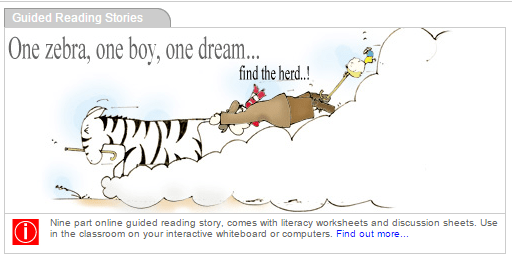
The Guided Reading Stories section is a nine part story that can be used with lower/middle Primary and includes discussion sheets and resources which can support the use of language techniques, e.g. sentence structure.

RIG

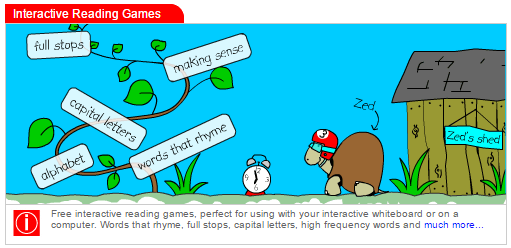
The Interactive Reading Games can be used in the lower/middle Primary to support the teaching of phonics, spelling and sentence structure. Although designed for the earlier stages of primary, these games may be appropriate in the upper Primary/ lower Secondary to consolidate technical accuracy when creating texts or when taking part in paired reading and writing tasks.

CLICK HERE – Roy the Zebra

Using text features . . . CHRISTMAS

As it’s the last week of term, and we’re in the Christmas spirit, why not use Christmas adverts for a compare and contrast lesson this week . . .

TCS

CLICK HERE – Christmas Adverts 2014 (The Independent)

A lesson suggestion . . . appropriate for all Levels through the BGE with differentiated levels of questioning and independence.

Christmas Adverts – compare and contrast

Significant Aspects of Learning – Reading

  • develop and use higher order thinking skills
  • use reading and listening  strategies to understand, analyse and evaluate texts
  • find and use information
  • develop critical literacy skills, including evaluating sources

Learning Outcome – I am learning how to compare the features used in two texts.

Step 1: Watch the Sainsbury’s Official Christmas Advert 2014 

Step 2: Use the Viewing Media questions to facilitate the discussion around the text, selecting the main ideas, emotions evoked and features used.

Step 3: Watch the John Lewis Official Christmas Advert 2014

Step 4: Use the Viewing Media questions to facilitate the discussion around the text, selecting the main ideas, emotions evoked and features used.

Step 5: Use the Text Structure – Compare and contrast hand-out to indicate the features pertinent to each of individual adverts and the features that both adverts possess.

CLICK HERE Christmas Advert – Compare and contrast lesson

Big Brown Bear – Literacy Software

BBB

Big Brown Bear has links to ten free online software resources that can be used to teach spelling, phonics, and language techniques.

A favourite is the Matching Suffixes game which is great for teaching word roots and suffixes. The Spelling and Beyond . . . PowerPoint from The Literacy Toolkit can be used to support professional development around the teaching of metalinguistics.

CLICK HERE – Big Brown Bear

Wikipedia – A Tool for 21st Century Literacy

Wikipedia – “Love it or hate it Wikipedia is a big part of our lives and its certainly a big part of our online browsing experience. Whether we admit to it or not many people consult Wikipedia on a regular basis to answer their questions. A large part of this is due to the fact that Google loves Wikipedia more than any other site on the Internet. In fact it gets presented as the top search result to more search queries than anything else, even Google itself.” – Ollie Bray

6a00d8341eb53c53ef01b7c702b524970b

When teaching Higher Order Thinking Skills (HOTS), and in particular the skill of critical analysis, websites such as Wikipedia are often hailed as an example of subjective inaccuracy.

However, check out the blog post below:
CLICK HERE – Seven Things You Didn’t Know About Wikipedia

Wikipedia has a number of uses:
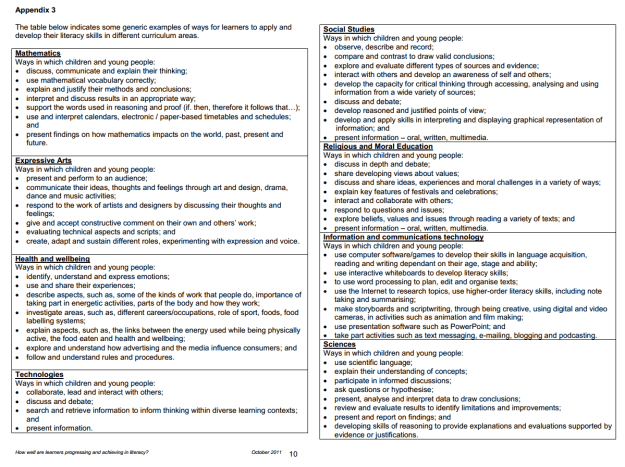
– promoting discussion around accuracy and validity – great for Critical Literacy
– providing real-time information – to support Reading for Information/ Shared Reading
– a forum to analyse and evaluate texts – identifying the Writer’s Craft
– access to multilingual language resources – including the Gàidhlig version of Wikipedia
– a tool to support referencing – highlighting the requirement for primary/secondary sources
– a facility to support journaling – a space to pull together relevant articles about a topic
– part of a family of resources – to support literacy across learning in the classroom.

Scots Language – Education Scotland

EdScot

Last week we met with Simon Hall – one of four Scots Language co-ordinators at Education Scotland whose remit covers Highland Council. He wrote the following piece about his time in Highland schools:

“A trip across the Pentland Firth to Caithness is always an exciting prospect, and it was really great to be in the northern county during Book Week Scotland to talk to local teachers and representatives from Highland Council about current developments in Scots Language education.

I received a lovely, friendly welcome at the linked primaries of Castletown and Canisbay, where we read ‘The Gruffalo’ in Scots translation. One or two of the bairns here knew some of the Scots vocabulary already, with one lass telling me her mum says her dad has ‘muckle hands’! The learners hadn’t heard the word ‘tod’ for fox before, but some of them did know about a place in Caithness called Todholes. I was learning, too, and picked up a Caithness word – ‘foosome’ – while in Castletown, as well as discovering that the word ‘peedie’, which I had thought was exclusive to Orkney, is also used in Canisbay and the surrounding north coast area.

A question that cropped up once or twice was ‘Is Caithness dialect really Scots language?’ The answer is yes, it certainly is a variety of Scots, and as such it is ideal for exploring in local schools. Primaries from as far afield as Shetland and South Ayrshire are beginning to consider the possibility of teaching Scots as the L3 within the government’s new 1+2 Languages framework.

Next stop was Thurso High, where English teacher Julie Adams showed me a fantastic resource she has been using: a ten volume Scots Dictionary. Ms Adams’ S1 pupils were enjoying exploring the dictionary, and were amazed to discover that it has over 60,000 entries. I had a long and interesting discussion with Craig Omand, D.H.T. at Thurso High, about Caithness language and culture, and about the new S.Q.A. Scots Language Award http://www.sqa.org.uk/sqa/70056.html.

I do hope that Highland secondary schools will give the Scots Language Award serious consideration: it offers a good opportunity to provide additional breadth of learning in the Senior Phase, as well as tapping fruitfully into the local culture of our school communities. The Award provides natural opportunities for interdisciplinary learning involving English, Music, Drama or Social Studies. Mr Omand gave me another Caithness word before I left – ‘raxter’. I’ve had a look at the new online Dictionary of the Scots Language to find out exactly what this one means: http://www.dsl.ac.uk/.

My Friday visits were in Wick, where I had lovely fish and chips and a tour of Pulteneytown Academy Primary with head teacher Miss Wark. I felt at home here, particularly seeing The Simpsons’ Groundskeeper Willie on the wall declaring ‘I’m fae Orkney!’ Miss Wark tells me that pupils at the new Newton Park school will say they are going ‘up til ae street’ in their new school building – I love these Caithness prepositions, and the unique definite article ‘ae’! Thanks finally to Miss MacArthur at Wick High School for taking a little time out on a busy Friday afternoon to hear about the Scots Language Award, and thank you to all of the teachers who were so friendly during my two days in Caithness.

If Highland practitioners would like to get in touch with me with any questions or comments regarding any of the above, or Scots language education in general, please send me an email at simon.hall@educationscotland.gov.uk .”

We look forward to working with Simon over the coming months. In the meantime, join the Scots Blether on Education Scotland to find out more about Scots Language:

CLICK HERE – Scots Blether

The Learning Zoo

The Learning Zoo, Anne Glennie’s (former Andrell Education consultant) new Literacy consultancy company has arrived.

TLZ


As part of the Reflective Reading CPD, Anne has created an area for practitioners to share resources. Check out The Teaching Trunk for more information.

TTT

As the website has been launched this week, Anne has created a Literacy Advent Calendar in the run-up to Christmas. Check it out each day to see what she has to offer.

TLZ2

Be sure to subscribe to the blog to receive posts as they’re published!