Author Archives: Mr Cook

International Literacy Day 2014

As you’re looking over your plans for next week, here’s an important date for your calendar . . .
Capture

Next Monday, 8th September 2014, people across the world will celebrate International Literacy Day, promoting Literacy for All.

Why not celebrate International Literacy Day within your class or as a school using some of the ideas below?  It’s a great opportunity for an Interdisciplinary Topic, encompassing Literacy, RME, Social Studies and Expressive Arts experiences and outcomes, as well as links with Global Citizenship and ECO. You could . . .

– Host a ‘book drive’ or a whole school ‘book swap’ in which children can choose a new book to read and enjoy

– Have a ‘book buddies’ morning – working with a different class in the school e.g. P1 and P4

– Invite a member of the local community e.g. local councillor, road crossing patrol, postman to come and share a story with the class

– Use the Global Dimension website to access resources to support Global Citizenship and Sustainable Development

– Celebrate cultures and diversity through each class hosting a different themed event from a country – CLICK HERE for an EXCELLENT link with stories linked to countries across the world.

CLICK HERE for TES and TES iBoard resources for ILD.

Leave a comment to let us know of any resources that you are aware of to support International Literacy Day.

Choosing a ‘good-fit’ text . . .

How do you support learners in making a ‘good-fit’ choice when choosing a text for independent reading?

Daily5 book cover1.jpg

The Daily 5‘ by Gail Boushey and Joan Moser is packed full of fantastic structural techniques to support your literacy programmes.

The I PICK strategy is used to teach learners how to select a text that is a ‘good-fit’ for them.

IPICK

A PowerPoint template on how to introduce this strategy can be found below.

CLICK HERE – I PICK PowerPoint

Question Bubbles

QuestionBubbles

The theme of questioning and higher order thinking has been a focus in some of our blog posts this month.

Working with the new PGDE Primary students at UHI today on Literacy in the Early Years, it was highlighted that developing the required questioning vocabulary is crucial in the early stages of learning – providing learners with the opportunity to ask and answer questions. This is also highlighted in the POLAAR resource from Education Scotland.

mrspancake

The following resource – very simple yet visually engaging – can be found on a fantastic website mrspancake.com. Used with the class during a range of lessons including guided reading, individual learning conferences and numeracy lessons, question bubbles are a visual way to introduce questioning vocabulary.

CLICK HERE – Question Bubbles Mrs Pancake

Many of the resources are free; however, the website kindly accepts donations.

Let us know of any resources you use to promote questioning in the Early Years by leaving a comment.

Writing a Literacy Policy in Highland Schools

ls

The Highland Council Literacy Strategy outlines that each school should have a Literacy Policy – an essential element which is required to support the development of literacy.

The following are advisory documents, and schools should not feel that these templates have to be followed if a suitable local alternative is preferred.

The following papers and templates are designed to support schools looking to get a Literacy Policy off the ground and to advise those who may wish to amend an existing policy. It is crucial that this policy is a live document which all staff contribute to.

Download the relevant paper and template below:

PRIMARY
Writing a Literacy Policy in Primary Schools – GUIDANCE
Writing a Literacy Policy – PRIMARY TEMPLATE

For more information contact james.cook@highland.gov.uk

SECONDARY
Writing a Literacy Policy in Secondary Schools – GUIDANCE
Writing a Literacy Policy – SECONDARY TEMPLATE

For more information contact donald.paterson@highland.gov.uk

Super Six for Comprehension . . .

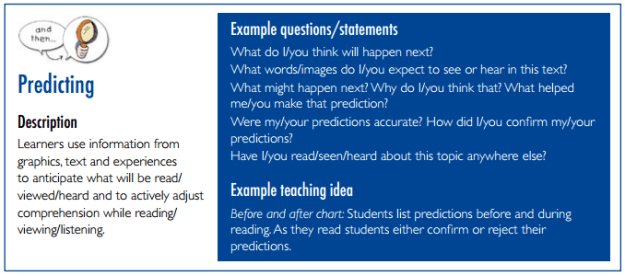
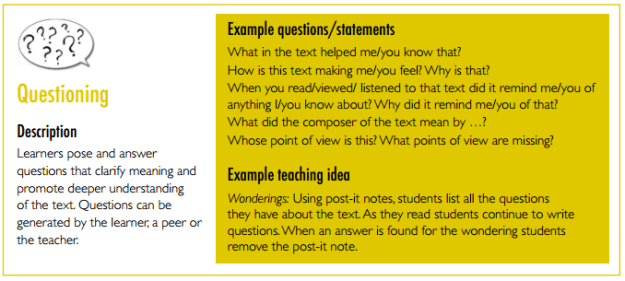
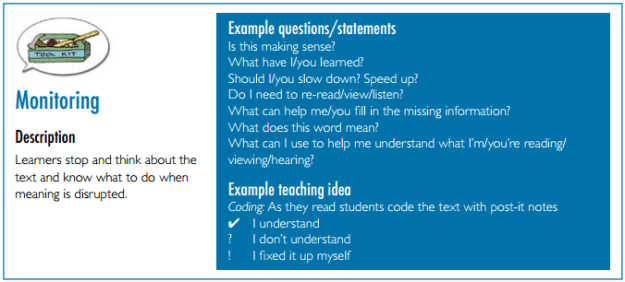
Making Connections, Predicting, Questioning, Monitoring, Visualising and Summarising . . . better known as the ‘Super Six’! The ‘Super Six’ are strategies which can be used to teach the skill of comprehension.

Many of you may already incorporate these into your reading and listening/talking programmes.

123456
CLICK HERE to download a printable sheet with an overview of the ‘Super Six’.

CLICK HERE for more information, from New South Wales, about the ‘Super Six’ including learning and teaching ideas to facilitate each of the strategies.

Education Scotland have more information regarding reading strategies, including guidance on The Thinking Reader and using The Thinking Reader Booklet.

pinterest-icon_logoClick the image above to access ‘Super 6’ displays and lesson ideas on Pinterest.

This list is in no way definitive, simply another tool that can be added to your literacy tool-belt. Leave a comment to let us know of any other comprehension strategies you develop in your classroom . . .

Keyboarding Skills . . .

Are we providing our children with the opportunity to develop their typing skills?

kv

The average keyboarding speed for an adult is around 40 words per minute (w.p.m).

Typing Test allows you to take a free test to assess your typing speed. The test itself may be used as a personal challenge for individual pupils, or something that you wish to develop with groups of children. The games can then be used to develop the typing speed of learners.

CLICK HERE for games that are available on the Typing Test website that can be used to develop the typing skills of learners.

CLICK HERE to access typing lessons and resources from Sense-Lang.

BBC – Dance Mat Typing is another great website that can be used to develop typing speed.

CLICK HERE for a list of other various typing programmes which can be used to support learners. 

Dialogic Reading

In previous posts about higher order thinking have highlighted the power of using questions to develop the comprehension, knowledge of vocabulary, and reading processing skills of learners.

Dialogic Reading is an approach to guided reading which uses prompts and questions to enhance crucial reading skills – reading with, instead of to learners; an approach many of us may use subconsciously.

Watch the video below to see Dialogic Reading in action.

An approach which can be developed initially with learners in the Early Years and differentiated for more able older readers – the facilitator’s role is to use the PEER and CROWD structure. DR2

CLICK HERE for a detailed definition of PEER and CROWD.

You may wish to use the Bloom’s Taxonomy Resources to support the creation of WH-Prompts.

Watch the video below to give you an idea of how you may wish to set up your text for Dialogic Reading.

cpd

Dialogic Reading is something you may also want to share with parents and carers – an excellent way of involving them in their child’s learning. Help is at hand! The Educational Psychology team are launching their Parent Reading Resource across the Authority at the beginning of the session. They are hosting CPD events in October and November to train Teachers and Pupil Support Assistants in how to deliver the reading support pack to parents and their children. Check it out by typing ‘literacy’ into the search bar on the CPD Calendar.

The following dates have been confirmed, with one other event to be added to the calendar in the Lochaber area.

Monday 6th October 2014 – Dingwall Education Centre, Dingwall – 9.30am-3.30pm
Monday 3rd November 2014 – Brora Community Centre, Brora – 9.30am-3.30pm
Tuesday 4th November 2014 – Miller Academy, Thurso – 9.30am – 3.30pm
Friday 21st November 2014 – Culloden Free Church, Inverness – 9.30am-3.30pm
Tuesday 25th November 2014 – Culloden Free Church, Inverness – 9.30am-3.30pm

Enjoy your first day back at school today!

Probationers 2014/2015 – Welcome to Highland!

cpd

It was great to see the buzz at Milton of Leys this afternoon – a troop of new Probationers, ready to embark on the first year of their career. Anticipation for Monday, no doubt, ready for your first week at the chalk face.

As mentioned at the introduction day, there are two Literacy CPD training programmes available for Probationers currently. These are to be applied for through the CPD calendar, following the link below:
http://highland.cpdservice.net/

Primary

A two day Literacy programme [with an optional third day dedicated to writing] designed to combine the work of the Highland Literacy Project, alongside the recent developments of the Highland Literacy Group, giving you practical suggestions on how to embed Literacy within your classroom.

Group A – Day 1 – Monday 15th September 2014 & Day 2 – Monday 10th November 2014
Group B – Day 1 – Tuesday 16th September 2014 & Day 2 – Tuesday 11th November 2014

Day 3 should be applied for separately after consultation with your Head Teacher/ Probationer Mentor.

Group A – Day 3 – Monday 20th April 2015
Group B – Day 3 – Tuesday 21st April 2015

Secondary – Teachers Not of Languages

A one day CPD event which equips practitioners with the rationale behind, as well as resources to embed literacy across learning within their subject area.

Group A – Wednesday 12th November 2014
Group B – Tuesday 25th November 2014

In the meantime, subscribe to our blog to keep up to date with the latest Highland Literacy developments.

CLICK HERE – Following the Highland Literacy Blog Guidelines

Slow Writing – don’t be afraid to apply the brakes . . .

Thank you to Wendy from Bishop Eden for flagging-up the original website that has inspired this post.

SW1

Teaching children through a ‘read to write’ model using Writer’s Craft lessons, exploring the fundamental principles of VCOP in ‘Big Writing‘, or teaching the individual traits in ‘6 Traits + 1‘ is common practice in Highland classrooms. However, a blank page for some learners continues to be a daunting prospect during the writing lesson.

The Slow Writing methodology allows practitioners to apply the brakes during the writing process, providing learners with a step-by-step structure to create their text. A spin on using a writing-frame, Slow Writing is a methodology similar to that of Up-Levelling within ‘Big Writing‘ and developing Sentence Fluency and Organisation in ‘6 Traits + 1‘.

The testimonials from practitioners suggest that Slow Writing allows learners to not only think about what they’re writing, but also how they are writing – slowing down the writing process to ensure high quality. Practitioners scaffold and model the different techniques within individual sentences, culminating in a finished piece of work. This could initially be introduced using a whole-class Shared Writing approach, developing independence and shifting to Guided Writing.

Interested in Slow Writing . . .
How is it used in Upper Primary/ Secondary?
How is it used in Lower/ Middle Primary?

CLICK HERE to access the Literacy Shed. They’re currently looking for practitioners to contribute to a non-profit Slow Writing Book.

CLICK HERE, or the image above, to access an interactive Slow Writing resource which can be used to generate sentence structure statements.

Give it a go . . . leave us a comment to let us know how you get on!

Primary One Literacy Assessment and Action Resource (POLAAR)

Education Scotland have recently released the Primary One Literacy Assessment and Action Resource (POLAAR).

The resource, used in the early stages of primary, aims to pre-empt future literacy difficulties – whilst also providing relevant activities and strategies which can support learners to achieve their full potential.

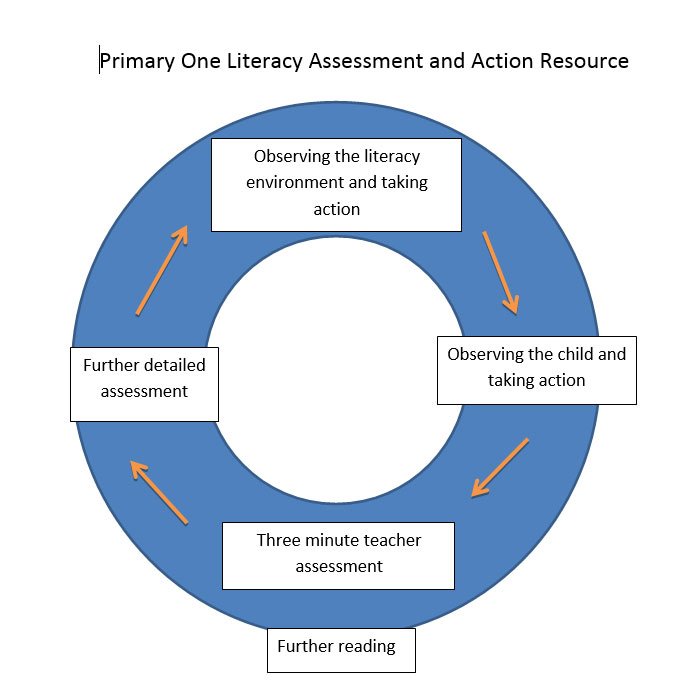
The resource follows a staged intervention, as follows:

polaar700_tcm4-835915

Observing the literacy environment and taking action
An audit tool which can be used by SMT/P1 staff to identify the opportunities that are currently provided – this is recommended as the first step in the action process.
CLICK HERE POLAAR Early Literacy Environment Assessment

Observing the child and taking action
Questionnaire done with selected individuals who teachers feel are at risk of literacy difficulties. The actions can then be used to support individual children at this stage; it would be good practice to begin a Form 1 to track the support given to individual learners.
CLICK HERE POLAAR Child Observation Assessment
CLICK HERE POLAAR Child Observation Assessment with Actions
CLICK HERE POLAAR Learning and Teaching Resources

Three-minute teacher assessment
After some time of embedding the actions, class teachers – in conjunction with relevant support staff – may wish to complete a further questionnaire, or alternatively use the three-minute teacher assessments. At this stage, class teachers would continue to use the recommended actions.
CLICK HERE POLAAR Three-Minute Assessment

The three-minute teacher assessments may also be something which SMT/ASN staff conduct across Primary 1, towards the end of the session, to track the three areas of literacy within the assessments. As each set of three assessment takes around ten minutes, class teachers may require support from a PSA/ASNT or a member of the SMT to conduct the assessments.

Further detailed assessment
The class teacher, in conjunction with the SMT, may feel it appropriate to undertake a more detailed assessment. Performance Indicators in Primary Schools (PIPS) may be purchased by the school as a standardised assessment – similar to Assessment for Excellence (AfE) at P3, P5 and P7.

Further reading
It is recommended that practitioners undertake further reading associated with the POLAAR resource. At Highland Literacy, we will also post relevant links and resources throughout the session which will support the use of the POLAAR resource.
CLICK HERE POLAAR Literature Summary
CLICK HERE POLAAR Research Project
CLICK HERE POLAAR Glossary of Terms

CLICK HERE to download a zip-file including all of the resources included in the POLAAR resource.