Equality and Diversity – Books for Children and Young People

Often we’re asked to recommend books – today we’re recommending a few which have some fundamental messages.

The Equalities Act (2010) places a duty on local authorities to eliminate discrimination, victimisation and harrassment with regards to the nine Protected Characteristics.

CLICK HERE – Equalities Act (2010) Information For Schools

Prejudiced based bullying can be prevented through education on Equality, Diversity and Children’s Rights and picture books are a powerful tool to deliver these messages.

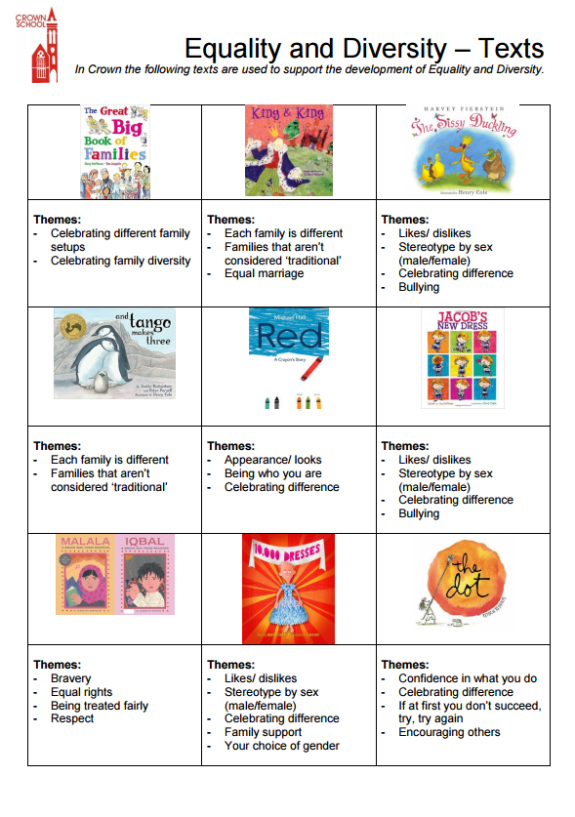
Click the images below to access a list of selected picture books that the Millburn ASG are using to develop Equality, Diversity and Children’s Rights. The Equalities Pupil Group at Crown last session identified the key themes which could be delivered through the books.

E_D1ed2

CLICK HERE – Equality and Diversity Picture Books

The Millburn ASG are working with the Council’s Equality Improvement Group and LGBTI+ Sub-group to develop lesson plans alongside these books. These will be shared in the 2017/2018 session.

CLPE – Reading and Writing Scales

The Centre for Literacy in Primary Education (CLPE) in England have worked with partners to create reading and writing scales for ‘beginning – mature independent’ readers and writers. The scales could be used alongside Steps to Success – The Highland Literacy Progression to support planning for progression.

rwscales

The scales describe the reading and writing behaviours that children may display at each stage from ‘beginning – mature independent’ and include next steps for each stage on the scale.

rscale

wscales

The reading and writing scales are tools which could support you in taking a developmental approach to reading and writing across the Broad General Education, building on from foundational reading and writing skills through Emerging Literacy.

CLICK HERE – CLPE Reading and Writing Scales


Pre-Handwriting – NEW and UPDATED Resources

Head over to the Pre-Handwriting page on the Emerging Literacy tab to see the updated and new resources from the Occupational Therapy department in Highland to support pre-handwriting development.

What’s new?

Most of the resources have just been updated with new links or a slight rearrangement of formatting; however, we also see two new resources:

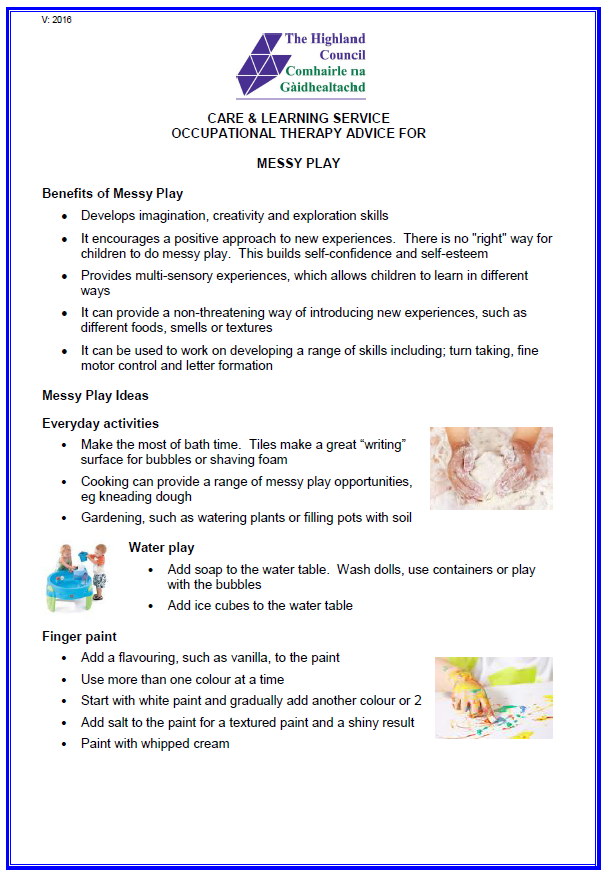
1. Messy Play

Access the Messy Play resource for sensory play experiences to support the development of fine motor skills and pre-writing skills.

mp1

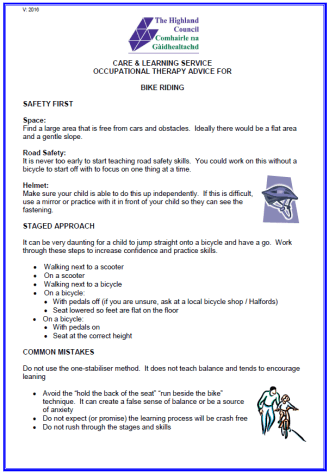
2. Bike Riding

Access the Bike Riding handout, ideal for families, to support the development of bike riding skills.

br

To download all of the revised handouts, click the link below – the most up-to-date resources are available via the Pre-Handwriting page.

CLICK HERE – OT Resources (March 2016)

Neil Gunn Writing Competition 2017

For Primary 5 – Primary 7 Pupils

The local to Highland Neil Gunn Writing Competition is extending its submission date for P5-P7 children across Highland until the end of term (April 5th) to provide schools with the time to get their submissions in. This is a great opportunity for children to create a piece of writing for a competition which celebrates the life of the Scottish writer Neil Gunn.

The theme for P5 – P7 is a quote from Neil Gunn’s writing:
“He was wakened by a loud knocking at the door.”  (The Well at the World’s End)

Children in P5-P7 can write a piece which is inspired by this quote, presented in either poetry or prose.

This is a valuable opportunity to develop purpose and audience for writing. Click the links below to access the competition information and entry form:

Entries for the Secondary and Adult competitions have closed- the deadline extension is only for Primary Schools

Pre Teaching Vocabulary – VIDEOS

During the filming which took place to create the Words Up Key Messages Videos, there were a number of great examples of Pre Teaching Vocabulary which have been captured on film.

PIPSTJOHN

The Building Vocabulary for Better Literacy PowerPoint within the Literacy Toolkit, suggests that in order to store new words effectively we need knowledge about three key areas:

  1. Word Knowledge (semantics)
  2. Phonological Awareness
  3. Kinaesthetic/ Visual Representation

The Pip St.John – Pre-Teaching Vocabulary resource provides free teaching materials which can be used when teaching learners new vocabulary.

Watch the videos below for examples of Pre Teaching Vocabulary being developed in the classroom, highlighting the use of gesture, repetition, linking to prior knowledge and consolidating phonological awareness to support the teaching of new vocabulary.

Pen Fifty Words – March 2017

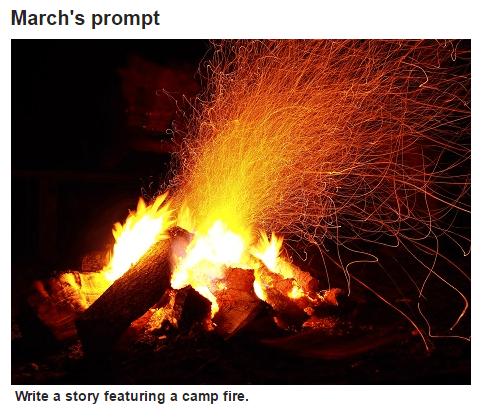
This month’s ’50 Word Fiction’ from the Scottish Book Trust features an image which captures storytelling at its best – the camp fire. Using the image below as a stimulus, learners can create a story of no more than 50 words.

campfire

Some campfire crackling sounds may help get the creative juices flowing. You could bring a virtual camfire into your classroom as part of storytelling. Check it out below:

The deadline is Tuesday 28th March 2017. The Young Writers category is open to all children and young people under 18.

CLICK HERE – 50 Word Fiction (The Camp Fire)

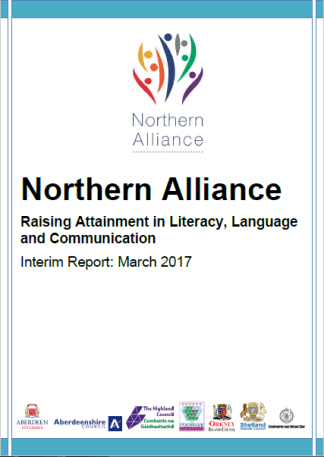
Emerging Literacy – Northern Alliance: Raising Attainment in literacy, language and communication – Interim Report – March 2017

As part of the Emerging Literacy development this year, as we shared in our post in December 2016, we are working with the other six local authorities across the Northern Alliance to further develop Emerging Literacy across the north of Scotland.

nair

As part of this we have undertaken midyear data analysis of Phonological Awareness and Pre-Handwriting as of January 2017 to compare with the baseline data which we gathered in September 2016 within these two domains. This, along with information on the progress made between June 2016 and March 2017, can be found in the report on the link below:

CLICK HERE – Northern Alliance: LLC Interim Report – March 2017

A final report will be published in July to detail the progress made over the academic year.

Writing Exercises

The Writing Exercises site has a number of prompts to support the writing process.

CLICK HERE: Writing Exercises

Check out the following resources for use in the classroom:

From the Children’s Section you can access a number of images in which learners can develop their descriptive vocabulary using images.

randompicture

CLICK HERE – Random Picture

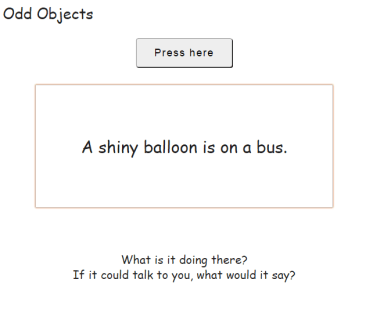
The Odd Objects section provides a stimulus for discussion which can lead to the writing process.

oo

CLICK HERE – Odd Objects

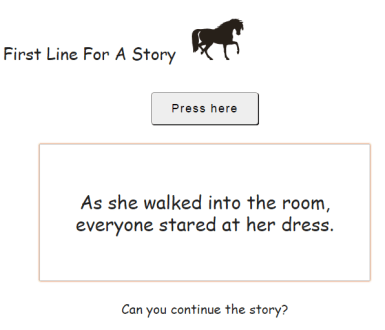
You can also generate a Random First Line of a story in which learners can continue.

fls

CLICK HERE – Random First Line

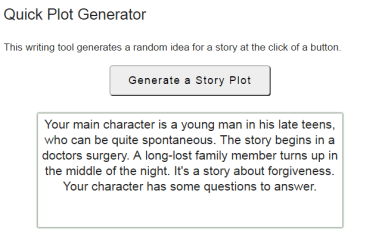
The Writing Exercises Main Site can be used to develop more advanced ideas. The Quick Plot Generator provides you with an outline of a creative text.

qpg

CLICK HERE – Quick Plot Generator

The Random First Line Generator can spark the beginning of a short story which can be further developed by learners.

rfl

CLICK HERE – Random First Line Generator